
Banner Blindness: The Banners in the Original Study Were Not Advertisements
The original banner-blindness study tested helpful content links, not just advertisements. Eye-tracking evidence reveals how tasks, page position and recall shape the finding.
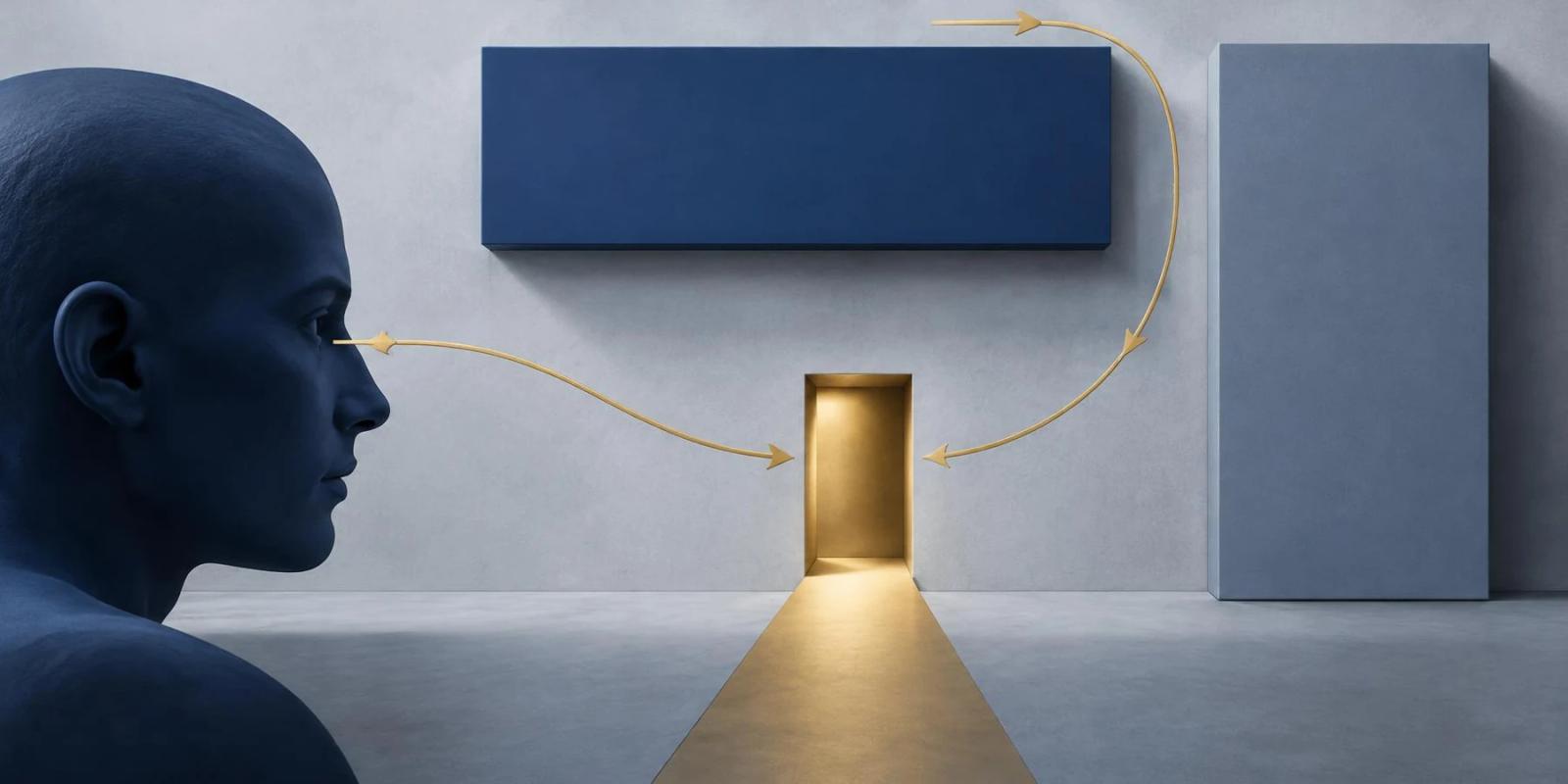
The useful finding here is not the one the term describes, and it has been sitting in the original 1998 study for nearly thirty years while almost everyone cited it for something else.
Jan Panero Benway’s participants missed banners. But most of Benway’s banners were not advertisements. They were legitimate, deliberately conspicuous content links - the actual answers to the tasks people had been asked to complete. Designers had made them large and colourful to help. That is precisely what made them invisible.
The real claim underneath “banner blindness” is therefore not people ignore ads. It is people learn to discard entire regions of a page by shape alone, and they will discard your content if it happens to be that shape. That is a finding about interface design, and it is much more interesting than the marketing version.
Where the term comes from, and how strong the foundation is
Three documents get conflated in citation lists, and it matters.
Benway, J. P. (1998), Proceedings of the Human Factors and Ergonomics Society Annual Meeting, 42(5), 463-467. A conference proceedings paper with a DOI. Real and citable - but conference proceedings, not a peer-reviewed journal article.
Benway, J. P., & Lane, D. M. (1998), the widely circulated web document from Rice University’s Internet Technical Group. Not peer-reviewed. It carries no journal masthead, no volume, no issue. It states outright that it is a secondary write-up of the conference presentation.
Benway, J. P. (1998), a Rice University doctoral dissertation, whose abstract uses the first person - “this phenomenon I call ‘banner blindness’ ” - confirming Benway as the coiner. Frequently cited as though it were a journal article.
Now the numbers, which are rarely quoted.
The pilot had six participants - three men, three women, working professionals. Banner-task success was about 58% against 94% for controls, t(5) = 2.80, p = 0.03. That six-person result is the significant finding in the founding work.
The second experiment had 72 undergraduates, and its headline timing comparison was null: control mean 6.02 seconds against 5.51 seconds when a helpful banner was present, Wilks’ Lambda F(2,59) = 0.97, p = .38. Seventeen of 71 participants recalled the non-advertisement banners, and only 20% said they recalled seeing any advertisements at all.
So: the most famous concept in this area rests on a conference paper and a non-peer-reviewed web document, whose main experiment produced a null and whose significant effect came from six people.
The strongest study, and its genuinely surprising result
Burke, Hornof, Nilsen and Gorman (2005), in ACM Transactions on Computer-Human Interaction, is the best work in this literature. Experiment 1 had 12 adults; Experiment 2 had 24 undergraduates. Eye-tracking with a chin rest, real gaze data rather than recall.
Participants looked at banners in 11.7% of trials - gray rectangles 8.8%, static commercial 13.0%, animated 13.2%. Banner type did not significantly change how often banners were looked at: F(2,32) = 1.28, p = .29. Seventy per cent of banner gazes happened during the very first eye movement.
Then the recognition test, and the finding that ought to be famous:
93.9% of correctly remembered banners had never been fixated.
Overall hit rate 20.1% against a false-alarm rate of 20.2%. Static banners were recognised above chance, d = 0.67, t(23) = 2.66, p = .01. Animated banners were not: d = -.07, t(23) = -0.3, p = .77. Static beat animated, t(23) = 2.14, p = .04 - the moving ads were remembered less well.
That 93.9% figure dismantles a whole tradition. Recall and gaze come apart so completely that any “banner blindness” claim measured by asking people what they remember is measuring something other than whether they saw it. Which is what almost all of the popular statistics do.
Burke and colleagues also found real costs. Workload rose with intrusive banners, F(3,36) = 6.52, p < .001, with flashing cyan text worst. In easy search, ads slowed people slightly: gray 2,040 ms, static 2,169 ms, animated 2,193 ms, F(2,46) = 5.5, p < .007. In hard semantic search, ads did not slow people at all: F(2,36) = 0.18, p = .83.
Funding: NSF Grant IIS-0308244. No industry money.
Blindness is a task effect, and it switches off
The modern eye-tracking work converges on one point: this is not a property of ad-shaped objects. It is what a task does to gaze.
Simonetti and Bigne, in the Spanish Journal of Marketing - ESIC, tracked 100 participants on a recreated sports news site with a Tobii X2-30. Ad fixation time was 5.5% of total time when reading an article and 11.9% when browsing for something to click, t(89) = 6.62, p < 0.001. Attention to ads roughly doubled when the task changed.
Position mattered under the reading task - F(2, 89) = 10.16, p < 0.001, with the middle banner at 2.48% beating top at 1.78% and bottom at 1.39% - and stopped mattering under the click task, F(2, 50) = 1.54, p = 0.224. They also found that full attention to a banner was not necessary for later recognition, echoing Burke.
Ispir, Kilic and Atar (2023), in Connectist, tested 160 students across four banner formats crossed with two motivational states.
| Banner position | Free surfing | Focused task |
|---|---|---|
| Top horizontal | 100% | 100% |
| Left vertical | 85% | 60% |
| Bottom horizontal | 80% | 95% |
| Right vertical | 70% | 15% |
Top banners were fixated by every single participant in both conditions. Right-hand banners collapsed from 70% to 15% when people had a job to do. Left banner F(1) = 15.498, p = 0.00, partial η2 = 0.21; top banner F(1) = 17.838, p = 0.00, partial η2 = 0.19; ad recall χ2 (1, n = 160) = 59.444, p = 0.000, φ = 0.61.
Hervet, Guérard, Tremblay and Chtourou (2011), in Applied Cognitive Psychology, asked the question directly in their title - is banner blindness genuine? Their objection is that the conclusion “rests mostly on indirect evidence that participants do not remember the ad content,” and that “it is unclear whether participants actually fixated the ads.” Their result: most participants fixated the ads at least once during their website visit. Congruent ads were better remembered than incongruent ones despite no difference in fixation duration.
And when ads are attended, they work
Simonov, Valletti and Veiga (2025), in the Journal of Marketing Research, ran the largest study here: 1,013 participants across the UK and US, desktop and smartphone, reading real articles from major news sites, with webcam-based gaze estimation.
The ratio of dwell time to visible time was around 18% for ads against around 50% for articles. So attention to ads is real but roughly a third of attention to content - a matter of degree, not a binary.
One extra second of ad dwell raised recall probability by 3.43 percentage points and purchase probability by 0.73 percentage points. One standard deviation of ad dwell - 3.16 seconds - raised recall by 10.83 points. Removing the ad increased article attention by about seven seconds, which the authors read as readers being ad avoiders.
The statistic to refuse
You will meet the claim that “86% of consumers suffer from banner blindness.” It comes from a press release by Infolinks, dated 19 March 2013 - a company that sells non-banner advertising formats, and therefore profits from the claim that banners fail.
The release states no sample size and no methodology, and links to no full report. The underlying claim is also not what the headline says: it is that only 14% of respondents recalled the last display ad they saw. That is a recall statistic relabelled as blindness - the exact inferential error Hervet and colleagues published against, and the one Burke’s 93.9% finding shows to be untenable.
Do not use it. The same applies to its companion figures from the same release, which are equally unsourced.
What this leaves you with
Banner blindness is a task-driven allocation of gaze away from page regions that look decorative - not an inability to see. It doubles or collapses depending on what the person is trying to do.
Position beats format. Top banners were fixated by 100% of participants in both motivational states; right-rail banners fell to 15% under a focused task. Where a thing sits matters more than what it looks like.
Animation does not fix it and may make it worse. Animated banners were not recognised above chance, and were recognised significantly less well than static ones, while raising measured workload.
The most important practical consequence is not about advertising at all. If your genuine content - a sign-up, a key link, an important notice - is styled like an ad and placed where ads live, it will be discarded by shape. That is what happened to Benway’s participants, and it is the finding the term was named after.
Be suspicious of any banner-blindness statistic based on recall. Nearly 94% of correctly recognised banners in the best eye-tracking study had never been looked at. Recall and seeing are not the same measurement.
For what an interface does when it withholds information to pull attention, see the curiosity gap. For visible counts and how they steer choice, see what visible metrics do. For the wider pattern, see the persuasive design guide.
Limitations of this article
The founding citation is weak - a conference paper and a non-peer-reviewed web document, with a six-person significant result and a null main experiment. We have said so rather than citing it as established.
The classic corpus is small and student-heavy, with samples of 6, 12, 22, 24 and 35, on mock websites rather than real ones.
We could not verify the sample sizes for Drèze and Hussherr (2003), Hervet and colleagues (2011), Resnick and Albert (2014), Owens and colleagues (2011), or Szladovics and Palmer (2024). We have therefore not printed figures from them, and have used Hervet only for its stated argument and headline conclusion. See the withheld-figures record.
The Ispir percentages are read from a table of fixation rates, not from an inferential test of each cell.
We read the Simonov statistics in an author-hosted manuscript, not the version of record, and the Simonetti volume and page numbers are disputed between two indexed records. Both are disclosed in the source-resolution record.
The largest modern study uses webcam gaze estimation supplied by a commercial advertising research agency - a weaker instrument than laboratory eye-tracking, and an affiliation worth knowing.
For readers applying the article’s finding to genuine sign-ups and content links, Leadpages is an existing HOS resource on building landing pages.

Human Operating System
Human Operating System is a research-led publication about the human mind under digital pressure. We report what the evidence does - and does not - support.
About Human Operating SystemSources & Further Reading
9 sourcesThese are the sources used for this article. Where a study's limits matter to the claim, those limits are kept in the citation.
View all 9 sourcesHide sources
- Burke, M., Hornof, A., Nilsen, E., & Gorman, N. (2005). High-cost banner blindness: Ads increase perceived workload, hinder visual search, and are forgotten. ACM Transactions on Computer-Human Interaction, 12(4), 423–445. Open source ↗
- Benway, J. P. (1998). Banner blindness: The irony of attention grabbing on the World Wide Web. Proceedings of the Human Factors and Ergonomics Society Annual Meeting, 42(5), 463–467. Open source ↗
- Benway, J. P., & Lane, D. M. (1998). Banner blindness: Web searchers often miss “obvious” links. Rice University Internet Technical Group. Open source ↗
- Hervet, G., Guérard, K., Tremblay, S., & Chtourou, M. S. (2011). Is banner blindness genuine? Eye tracking internet text advertising. Applied Cognitive Psychology, 25(5), 708–716. Open source ↗
- Ispir, N. B., Kilic, D., & Atar, G. M. (2023). Discovering banner blindness for different banner formats: An eye-tracking study. Connectist: Istanbul University Journal of Communication Sciences, 64, 99–121. Open source ↗
- Simonetti, A., & Bigne, E. Does banner advertising still capture attention? An eye-tracking study. Spanish Journal of Marketing – ESIC. Open source ↗
- Simonov, A., Valletti, T., & Veiga, A. (2025). Attention spillovers from news to ads: Evidence from an eye-tracking experiment. Journal of Marketing Research, 62(2), 294–315. Open source ↗
- Ning, B., Luo, S., Wang, A., & Zhang, M. (2023). Effects of banner ad type, web content type and theme consistency on banner blindness: An eye movement study. Cognitive Processing, 24(3), 313–326. Open source ↗
- Infolinks. (2013, March 19). Study: 86 percent of customers suffer from banner blindness [Press release]. Open source ↗
The Weekly System
Join the launch list for one calm, research-led email about attention, memory, learning and the systems designed to hold your attention. No noise, no panic and no unsupported certainty.