
Attention Design
Articles on how interfaces are built to hold attention: ranking, defaults, autoplay, infinite feeds and missing stopping cues. This is the area where the primary sources are strongest. Start with the guide, or browse the shorter pieces below.
Articles in this topic

The Psychology of Waiting: The Two Rules Everyone Quotes Are Not Findings
Progress feedback changes how waiting feels. The familiar response-time rules, labor illusion and vendor latency statistics have much weaker foundations than their repetition suggests.

Do People Read Terms and Conditions? 98% Agreed to Give Up a Child, in a Median of Fourteen Seconds
Almost nobody reads terms and conditions. Experiments, clickstream data and simplification trials show why, and correct two widely misquoted statistics.

Banner Blindness: The Banners in the Original Study Were Not Advertisements
The original banner-blindness study tested helpful content links, not just advertisements. Eye-tracking evidence reveals how tasks, page position and recall shape the finding.

Rage Bait: The Effect Is Real, and Smaller Every Time It Is Measured
Outrage content does spread further. But the best-known figure shrank from 20% to 13% when its own authors replicated it, and out-group content predicts sharing better than anger.

The Online Disinhibition Effect: Anonymity Is Not the Reason
Experiments that manipulated anonymity found little. Mood and the surrounding norm predicted hostile comments better than masks did.

The Filter Bubble: They Switched Off the Algorithm for 23,000 People
Pre-registered experiments switched off the feed algorithm during the 2020 US election. Exposure changed a great deal; political attitudes did not.

Confirm shaming: It Works, By About Five Points, Until Money Is Involved
Confirm shaming, measured: guilt-worded decline buttons lift acceptance by about five points, but the effect stopped reaching significance once people had to pay.

The Roach Motel: Easy In, Hard Out - and What the Measurements Show
The roach motel dark pattern, measured: cancelling takes more clicks than subscribing, but the strongest evidence says attention, not friction, keeps you paying.

Should You Accept Cookies? What the Banner Is Designed to Make You Do
Should you accept cookies? What 'Accept all' really consents to, and what field experiments show banner design does, and does not do, to your click.

The Curiosity Gap: The Mechanism Is Real, the Industry Built on It Mostly Does Not Work
The curiosity gap is a real feature of the mind, peaking when you half-know something. The headline industry built on it mostly loses to headlines that say what the story is.

Left on Read: What a Read Receipt Actually Does
A read receipt does not tell you why someone has not replied, it changes what you assume. The measured effect is on opening messages, not on replying.

Infinite Scroll: The Stopping Cue That Was Removed
Pagination was a stopping cue, and removing it was documented while its effects never were: no experiment compares infinite scroll with a paginated feed.

What Visible Metrics Do to Your Decisions
Randomised experiments show visible counts change what you sample far more than what you conclude - and the effect is modest, topic-dependent and often self-correcting.

The Duolingo Streak: What the Number Is Actually Doing
Duolingo has published no peer-reviewed research on streaks, and its own A/B tests put the effect at a fraction of a percent. What the independent literature actually shows.

Why TikTok Is So Addictive
What the recommendation system is documented to do, what the research measures, and why the word addictive is doing more work than the evidence.

What Your Feed Knows About You That You Will Not Admit
Your feed seems to know the version of you that you would not admit to. It does, because it learns from what you do, not what you say. Here is what a social media algorithm actually reveals, why it is neither mind control nor neutral, and how to use the mirror.
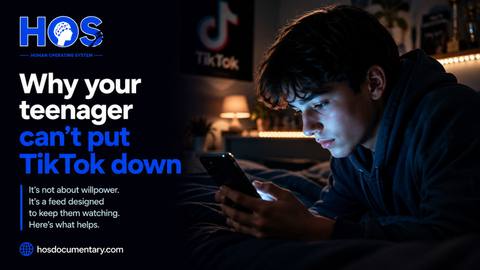
Why your teenager can't put TikTok down
When your teen says "five more minutes" and means it, and an hour later is still scrolling, the difficulty is not discipline. It is a feed built specifically for them. Here is what is really happening, and what actually helps.

Why You Can't Stop Scrolling in Bed at Night
The reason the loop repeats isn't the one you've been blaming, which means the fix isn't the one you keep failing at. It isn't weak willpower - it's the setup.
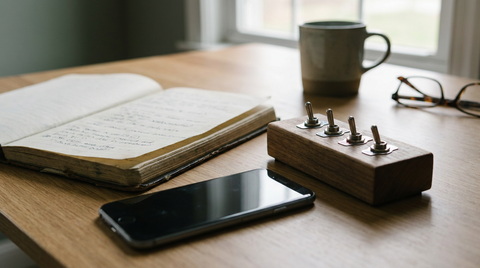
Your phone isn’t the problem. Its defaults are.
The reason you keep checking your phone has less to do with willpower than with the phone itself: it is a carefully tuned object, and almost nothing about how it behaves was set by you. The useful move is to change the defaults so the device stops fighting your attention.

The Doomscrolling Loop: Why Bad News Feels Impossible to Put Down
Why does one alarming headline turn into twenty minutes of scrolling that resolves nothing? The evidence behind the doomscrolling loop, and how to interrupt it.
The Weekly System
Join the launch list for one calm, research-led email about attention, memory, learning and the systems designed to hold your attention. No noise, no panic and no unsupported certainty.