
Your phone isn’t the problem. Its defaults are.
The reason you keep checking your phone has less to do with willpower than with the phone itself: it is a carefully tuned object, and almost nothing about how it behaves was set by you. The useful move is to change the defaults so the device stops fighting your attention.
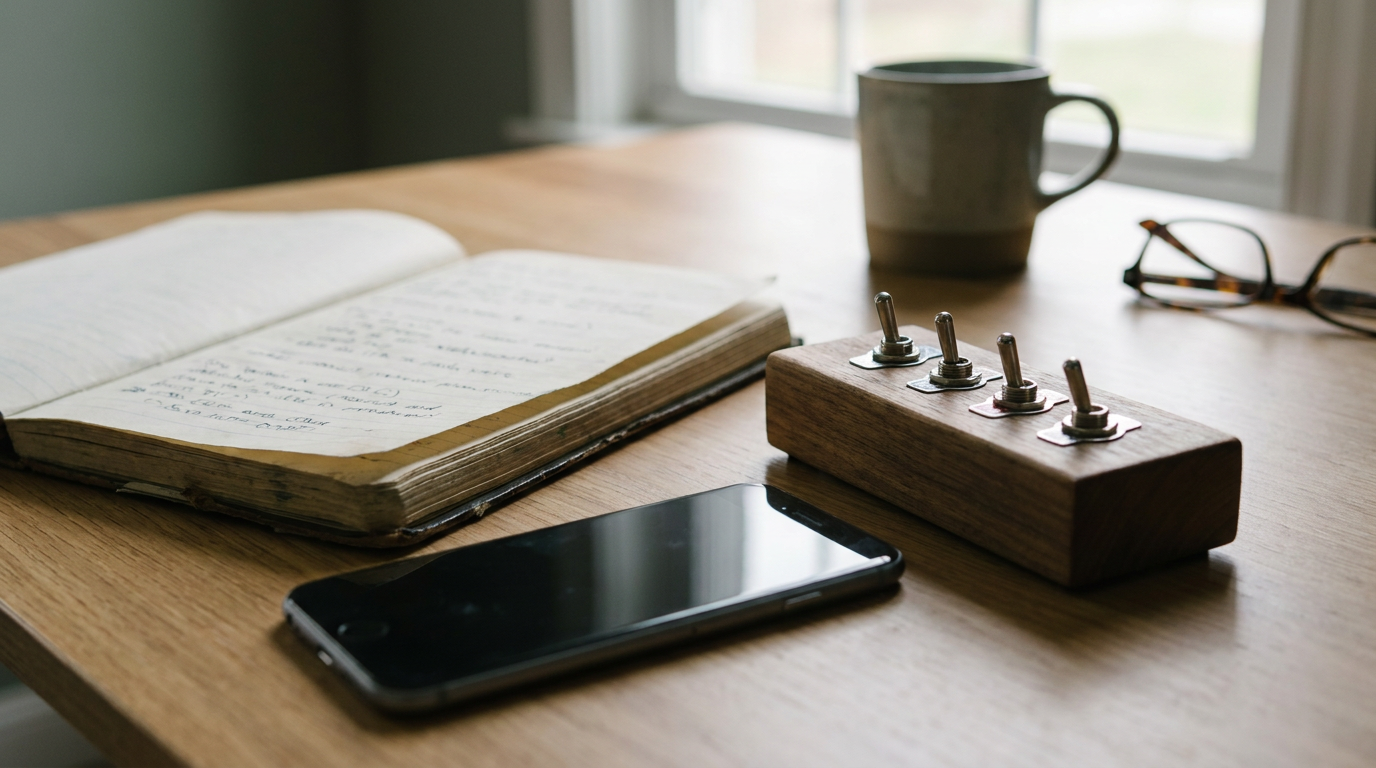
You put your phone face-down so you could finally get something done. A minute later it buzzes. You tell yourself you'll ignore it.
Then you flip it over - just to check - and the next time you look up, twenty minutes are gone and the thing you sat down to do is still sitting there.
If that's you, you've probably decided the problem is you. Not enough discipline. Too little willpower. Something you keep failing at.
It isn't.
The reason why you keep checking your phone has less to do with your willpower than with the phone itself: it's the most carefully tuned object you own, and almost nothing about how it behaves was set by you.
It's not a willpower problem
Let's put the self-blame down, because it's aimed in the wrong direction.
Your phone is the end product of an entire field of work - persuasive design - built around making devices and apps easier to keep using. (B.J. Fogg's Persuasive Technology named this field two decades ago.)
These products are built by teams whose success is often measured by whether people come back. You're one person with a tired brain at the end of a long day. It isn't a fair fight, and losing it says nothing about your character.
So the useful question isn't "why can't I control myself?" It's "who set this thing up - and can I change it?"
Your defaults were chosen for you
Here's a pattern that shows up everywhere people make choices: we tend to keep whatever is already switched on.
The clearest evidence comes from an unlikely place - organ donation. In a well-known study in Science, Eric Johnson and Daniel Goldstein found that countries where people are donors by default have donor rates above 90%, while otherwise-similar countries where you have to opt in sit far lower.
Same people, same values. The main difference was the default - and the small effort it takes to change it.
That's the quiet engine inside your phone, too. Every setting has a starting position someone else picked. Changing it takes a few taps and a bit of attention - and "a few taps and a bit of attention" is exactly what most of us never get around to spending.
Leaving everything on costs nothing. Turning it off costs effort. So the default wins, day after day.
Your phone isn't beating your willpower. It's beating your to-do list.
The settings doing the work
Look at what those defaults actually are. On most phones, many of these are enabled, easy to leave on, or designed to be frictionless enough that you never think to change them:
Notifications from nearly every app, not just from people.
Little red badges counting things that feel urgent and usually aren't.
Feeds that scroll forever, with no natural place to stop.
Video that autoplays the next thing before you decide to watch it.
Recommendations tuned to keep you looking.
None of this is an accident, and some of the people who built it will tell you so. Aza Raskin, who invented the infinite scroll, has said publicly that he regrets it - that it was designed to keep people going past the point where they'd otherwise stop.
You don't have to assume bad intent to notice the obvious: these patterns exist to extend your time, not to protect it.
And the cost is real even when you don't give in. In one experiment, simply receiving a notification - without checking it - was enough to measurably hurt people's performance on the task in front of them (Stothart and colleagues, 2015).
Research on interrupted work finds we do get back to the task, but at a price in speed and stress (Gloria Mark's work at UC Irvine). Some studies even suggest that just having your phone nearby can occupy a little of your attention - though that particular finding is debated.
The point is that this isn't in your head. It's in the design.
The good news hides in the same place. Most smartphones also include tools to change many of these settings - Focus and Screen Time on iPhone, Digital Wellbeing on Android. The defaults were chosen for you, but they aren't locked.
The ten-minute reset
You don't need a new personality. You need about ten minutes and a willingness to experiment. Try these for a week and notice what changes - for many people, this alone can take a lot of the pull out of the phone:
Turn off notifications for everything that isn't a real person. Messages from humans can stay; the rest can wait.
Remove the red badge counts. If a number isn't an emergency, it doesn't need to glow on your home screen.
Put Focus / Do Not Disturb on a schedule - work hours, dinner, the last hour before bed.
Turn off autoplay so the next video has to be your choice, not the app's.
Move your most bottomless apps off the home screen. One extra swipe is often enough friction to break the reflex.
Try grayscale for a week. When the screen stops being candy-colored, some people find it quietly less magnetic (there's real, if modest, evidence for this).
Charge your phone somewhere other than your bedroom. The simplest boundary is distance.
Notice the pattern: you're not fighting the phone with willpower. You're changing its defaults so it stops fighting you.
What this will - and won't - do
Be honest with yourself about the size of this. Changing your settings won't hand you laser focus, fix a hard week, or replace sleep and rest.
Researchers who study screens and well-being generally find the average effects are smaller than the headlines suggest (Orben and Przybylski, 2019), and even something like grayscale helps some people a lot and others barely at all.
That's fine. This isn't a cure, and it isn't a character test. It's removing a few thumbs that were pressing on the scale - so that when you do decide to focus, you're not also quietly fighting a machine that was set up to keep you scrolling.
If you want to go further
For deeper reading, Digital Minimalism by Cal Newport is a strong place to start - but the checklist and one sec are the practical first step.
Coming soon in this series: a hands-on comparison of the focus apps that actually block distraction - and the ones that don't. For the bigger picture, see our guide to persuasive design - how interfaces are built to hold attention in the first place.

Human Operating System
Human Operating System is a research-led publication about the human mind under digital pressure. We report what the evidence does - and does not - support.
About Human Operating SystemSources & Further Reading
9 sourcesThese are the sources used for this article. Where a study's limits matter to the claim, those limits are kept in the citation.
View all 9 sourcesHide sources
- Johnson, E. & Goldstein, D. (2003) - "Do Defaults Save Lives?" (Science).
- Stothart, C., Mitchum, A. & Yehnert, C. (2015) - "The attentional cost of receiving a cell phone notification" (Journal of
- Experimental Psychology: Human Perception and Performance).
- Mark, G., Gudith, D. & Klocke, U. (2008) - "The cost of interrupted work: more speed and stress" (CHI '08).
- Apple - Focus, Screen Time & notification settings documentation; Google - Android Digital Wellbeing documentation.
- Holte, A. & Ferraro, F. (2020) - "True colors: grayscale setting reduces screen time" (The Social Science Journal).
- Orben, A. & Przybylski, A. (2019) - "The association between adolescent well-being and digital technology use" (Nature
- Human Behaviour).
- Fogg, B.J. (2003) - Persuasive Technology
The Weekly System
Join the launch list for one calm, research-led email about attention, memory, learning and the systems designed to hold your attention. No noise, no panic and no unsupported certainty.