
Why your teenager can't put TikTok down
When your teen says "five more minutes" and means it, and an hour later is still scrolling, the difficulty is not discipline. It is a feed built specifically for them. Here is what is really happening, and what actually helps.
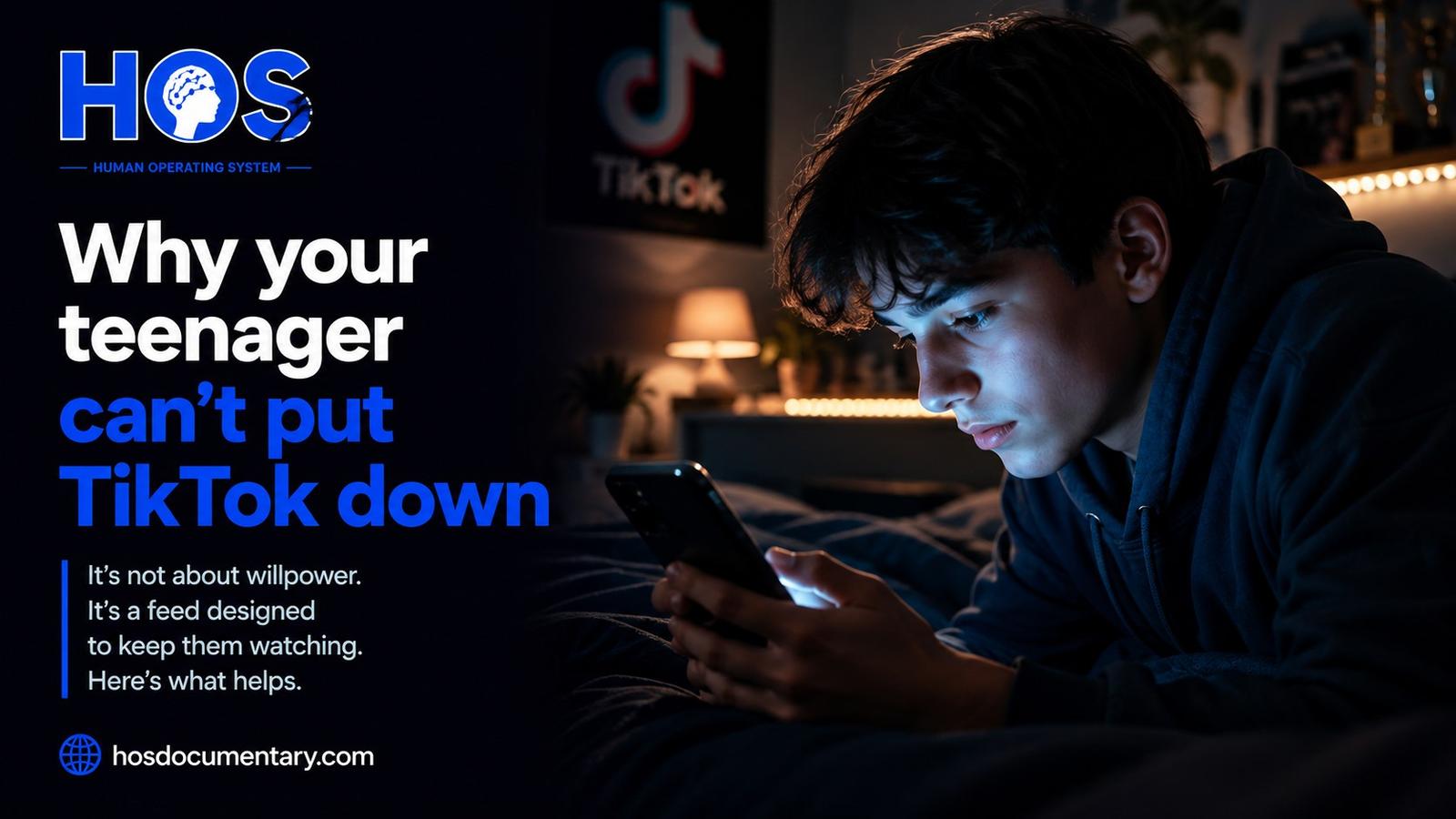
"Five more minutes," they say. It is 11pm, and the phone is lighting their face in the dark. You check back at midnight and they are still there, thumb moving, eyes glassy.
Here is the part that confuses parents most: they were not lying to you. When they said five minutes, they meant it. And it still did not happen.
If you have concluded that your teenager simply has no self - control, it is worth a second look, because what they are up against is not a test of discipline they keep flunking. It is one of the most refined attention systems ever built, tuned specifically to them, and "I'll stop in five minutes" was never going to beat it on sincerity alone.
They mean it, and it still doesn't happen
Start with that gap, because it is the whole story. Your teenager genuinely intends to stop. Then a stretch of time disappears and they are still scrolling, a little surprised themselves.
That is not what defiance looks like. It is what it looks like when a person's intention keeps getting quietly overridden by something. To help them, you have to understand what that something is.
A feed built for them, specifically
TikTok's core is its For You feed, and it does not work like flipping channels. It is a recommendation engine that learns, in real time, what holds this particular person's attention, and serves more of it.
TikTok has described how it works. The system watches your signals - which videos you like, share, and finish, what you search for, the accounts you follow - and, crucially, it weighs how you watch.
By the company's own account, a strong signal like finishing a longer video counts for more than a weak one. In other words, the feed learns from behaviour more than from anything you say. Your teenager never has to tell TikTok what they like; the way they watch tells it, hundreds of times an hour, and it adjusts.
The result is a feed that is not generic and forgettable but personalised and sharpening - a stream tuned to your specific teenager's attention, getting steadily better at holding it the longer they watch. That is what "five more minutes" is trying to overcome.
It is not a stranger's feed or their little brother's. It is a feed assembled, video by video, out of their own attention.
Two features that seal it
Two design choices finish the job. First, there is no built - in place to stop. The feed is endless and it autoplays - the next video begins on its own, so the moment of decision ("do I keep watching?") never actually arrives.
You do not choose to continue; you have to choose to stop, against a stream that never pauses to let you.
Second, the payoff is unpredictable. Most videos are fine, some are dull, and every so often one is genuinely great, and you never know which the next one will be.
That "maybe the next one" uncertainty happens to be the pattern that most powerfully holds attention: an unpredictable reward keeps you pulling the lever far longer than a predictable one would. Your teenager keeps flicking upward partly because the great video might be one more swipe away, and occasionally it is.
Put the personalised engine together with the endless autoplay and the uncertain payoff, and "I'll stop in five minutes" is being asked to beat a system engineered, precisely, so that five minutes does not happen.
Why teenagers, especially
It is fair to ask why this hits teenagers harder than it hits you. Part of the answer is developmental: adolescence is a stretch of heightened sensitivity to social feedback and reward - being seen, being liked, being in on the joke - which is much of what TikTok delivers.
A feed rich in social reward meets a brain that is, at that age, especially tuned to it. That is not a flaw in your teenager; it is simply where they are in growing up, and the design happens to land right on it.
A careful line here, because it matters: saying teenagers are more sensitive to social reward is not the same as saying TikTok is damaging their brains. That is a much larger claim, and the evidence does not support stating it as fact. Keep the two apart.
What the research does and does not show
This is where a lot of scary writing goes off the rails, so here is the honest state of it. There are studies linking heavy short - video use to poorer sleep and to more self - reported attention problems in young people. Those associations are real and worth taking seriously.
But they are correlations, drawn mostly from surveys taken at a single point in time. They cannot tell us which way the arrow runs. Heavy scrolling might worsen sleep - or teenagers who already sleep badly or struggle to focus might reach for the endless feed more. Almost certainly it runs both ways.
So the fair statement is this: heavy short - video use is associated with worse sleep and more attention complaints, which is reason to take it seriously, not proof that TikTok causes either. HOS will not tell you the feed is rewiring your child, because no one can honestly tell you that yet.
Where the responsibility actually sits
So set the "no self - control" story aside. Your teenager is an ordinary young person with an ordinarily developing brain, up against a personalised attention engine with no off - switch and an unpredictable reward - the kind of thing that holds adults too.
Losing an hour to it is what the system is built to produce, not evidence of a broken character. Framing it that way does two useful things at once: you stop being angry at your teenager, and they stop having to defend themselves, which frees them to actually work on it with you.
What actually helps
You cannot out - discipline the feed, and neither can they. What works is changing the situation, not demanding more willpower.
Use the built - in limits, together.
TikTok applies a default sixty-minute daily screen-time limit for under-eighteens (they enter a passcode to continue past it) and offers Family Pairing, which lets a parent link their account to a teen's and manage screen time, comment settings, and more. Teen accounts also get no push notifications overnight - from 9pm for thirteen to fifteen-year-olds, and 10pm for sixteen and seventeen-year-olds.
None of these is a wall, but each adds a moment of friction - a point where the endless stream is interrupted and a choice becomes possible. Set them up with your teen, not behind their back.
Retrain the feed if it has gone somewhere bad.
Because the feed is built from behaviour, it can be reshaped. If it has drifted somewhere unhealthy, TikTok allows refreshing or resetting recommendations and offers content controls. A feed pointed somewhere better pulls less.
Get the phone out of the bedroom at night.
This is the highest - value single move, because night is when the feed does its worst - no reason to stop, no one to notice, and tomorrow's tiredness feels far away. A phone charging in the kitchen overnight ends the midnight scroll more reliably than any lecture.
Have the conversation, not the confiscation.
Snatching the phone tends to teach a teen to guard it and hide their use. A calm conversation - the kind our guide on talking to your teen about their phone without a fight lays out - about what the feed is doing and how to blunt it treats them as a partner, and that is the version that lasts.
The version that helps
Your teenager cannot put TikTok down because TikTok is very, very good at not being put down, personally, for them. Say that to them out loud - it takes the shame out of it and puts the difficulty where it belongs, on the design rather than their character.
Then change the setup together, the limits, the feed, and above all the phone out of the bedroom at night, and stop asking a fifteen - year - old to win, on willpower alone, a contest built for them to lose. The same endless-feed design shows up off TikTok too; see The Doomscrolling Loop for why bad news pulls at you the same way. If you also want limits on the device, we compare the screen-time and parental control apps worth paying for. For the wider picture of how these interfaces are built to hold attention, see our guide to persuasive design.

Human Operating System
Human Operating System is a research-led publication about the human mind under digital pressure. We report what the evidence does - and does not - support.
About Human Operating SystemSources & Further Reading
4 sourcesThese are the sources used for this article. Where a study's limits matter to the claim, those limits are kept in the citation.
- TikTok Safety Center - Guardian's Guide: built-in teen protections including the 60-minute default screen-time limit, quiet hours, and Family Pairing (tiktok.com/safety/en/tools-and-guides/guardians-guide).
- TikTok Safety Center - Making Your Feed For You: how the For You recommendation system works, and how to reset it (tiktok.com/safety/en/tools-and-guides/making-your-feed-for-you).
- Jiang, L. & Yoo, Y. (2024). Adolescents' short-form video addiction and sleep quality: the mediating role of social anxiety. BMC Psychology, 12(1), 369 (cross-sectional).
- Chiencharoenthanakij, R. et al. (2025). Short-form video media use is associated with greater inattentive symptoms in Thai school-age children. Brain and Behavior, 15(7), e70656 (cross-sectional).
The Weekly System
Join the launch list for one calm, research-led email about attention, memory, learning and the systems designed to hold your attention. No noise, no panic and no unsupported certainty.