
Why You Can't Stop Scrolling in Bed at Night
The reason the loop repeats isn't the one you've been blaming, which means the fix isn't the one you keep failing at. It isn't weak willpower - it's the setup.
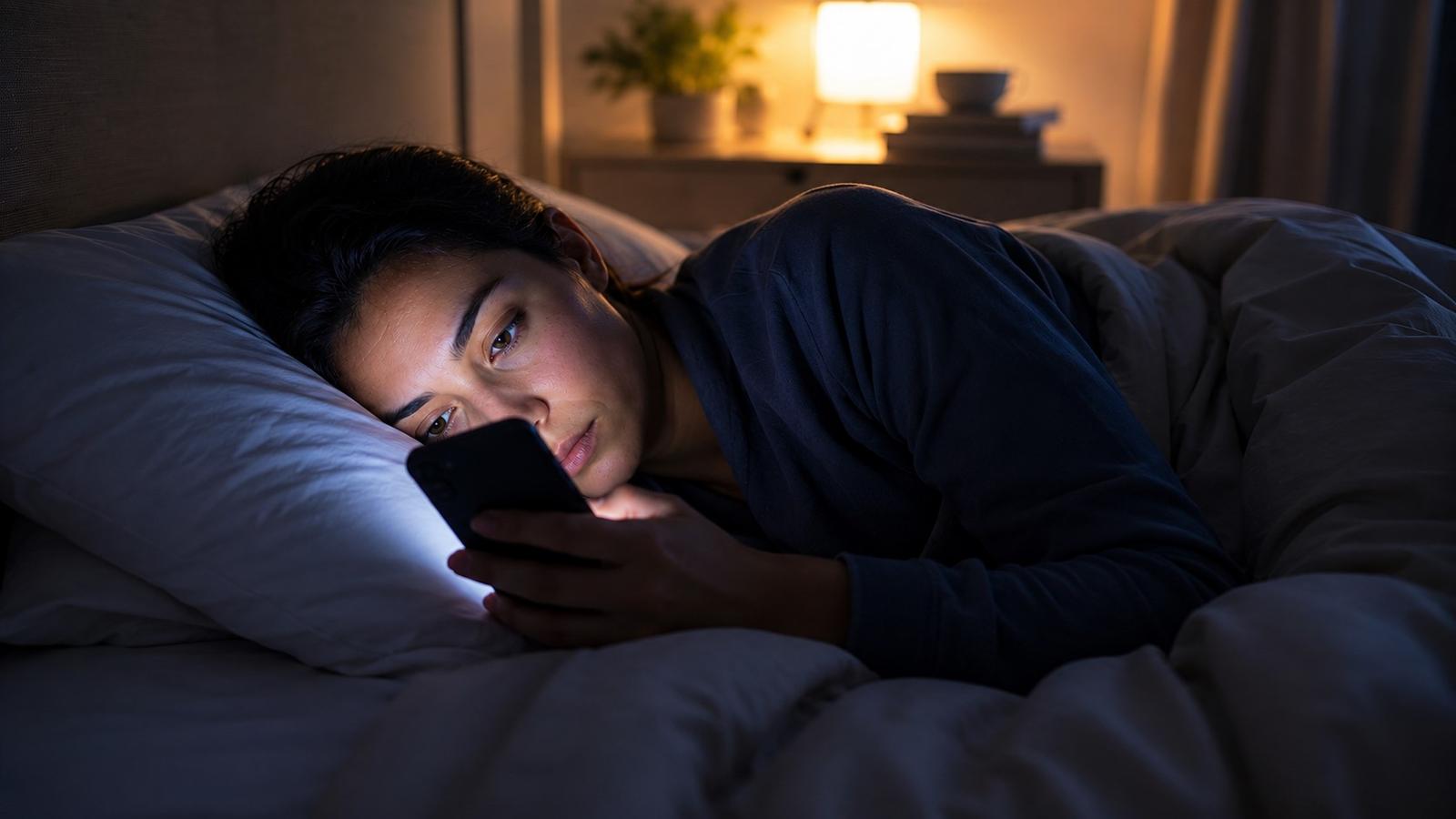
The lights are off. Your eyes sting. You promised yourself an early night, and the phone is in your hand anyway - one more video, one more scroll, one more and then you'll stop.
Then it's past midnight. You're more awake than when you got into bed, the alarm is six hours away, and you already know tomorrow starts behind: foggy, short-tempered, running late, trailing that thin thread of guilt because you watched it happen and did it anyway.
Tomorrow night, tired again, you'll make the same promise and break it the same way.
Here's what's worth knowing:
The reason the loop repeats isn't the one you've been blaming, which means the fix isn't the one you keep failing at.
It isn't weak willpower - it's the setup. Late at night, worn down by the day, many people simply find it harder to stop doing something they enjoy; that's a normal tendency, not a character flaw, and "I'll put it down in a minute" is a promise your midnight self was never well placed to keep.
Researchers even named the pattern: bedtime procrastination, staying up on purpose with nothing stopping you, which is associated with less sleep and more next-day tiredness (Kroese et al., 2014; 2016).
You're also up against a device that never offers a stopping point - there's always a next thing, by design (the designer who created the infinite scroll has since said publicly that he regrets it; BBC News, 2018).
The content keeps your mind switched on when it needs to wind down, and a stimulated, racing mind is one of the known barriers to falling asleep (Harvey, 2000).
Screen light plays a smaller part - it can nudge your body clock later and raise alertness (Chang et al., 2015) - but it's one factor, not the villain, which is why the popular fix disappoints: a 2023 Cochrane review of 17 trials found blue-light-filtering glasses probably make little or no difference to sleep or eye strain (Singh et al., 2023), and either way they do nothing about the phone being in your hand.
In plain terms, bedtime phone use is broadly associated with worse and later sleep (Exelmans & Van den Bulck, 2016; Hale & Guan, 2015), mostly through an engaged mind and a later bedtime.
Now the honest part, because it's the reason to act tonight rather than "someday."
Leave the phone by the bed and the sequence is likely to run again: scroll, later sleep, a wired mind, a harder morning, a shorter fuse, the guilt - then the same thing tomorrow.
The cost isn't one bad night; it's the same night on repeat, quietly setting the tone for weeks of your mornings and moods. Nothing about it resolves on its own, because the setup that produces it stays exactly where it is.
Picture the other version instead:
A phone charging in the next room, a boring last ten minutes, and a morning where you wake up roughly on time and not already behind. That's not a personality transplant. It's a week-long experiment with a setup change.
Set a phone cutoff, 30 to 60 minutes before lights-out.
Charge the phone outside the bedroom. If it isn't in reach, there's no midnight decision to lose - distance beats discipline at midnight.
Replace the phone alarm with a real alarm clock. "I need it for the alarm" is the main reason the phone stays, so remove the reason.
Switch on built-in Downtime, Bedtime or Focus mode at your cutoff.
Make the last thing boring - a paper book, a dull podcast, quiet.
Dim the lights for the final stretch.
Keep the bed mostly for sleep.
You don't have to buy anything for this. Turn on Bedtime mode tonight and charge the phone in another room using any clock you already own - that free version does the whole job.
One predictable snag is the phone returning to the bedside "just for the alarm." For people who want to keep the phone outside the bedroom, a basic alarm clock is one optional alternative. A sunrise alarm clock may suit those who prefer a gentler wake-up, but neither device is required.
Be honest about the ceiling, too: this helps the habit, it doesn't cure insomnia or guarantee good sleep, and nights vary.
If your sleep problems are serious or persistent, that's worth raising with a doctor or qualified professional; this isn't medical advice, and it has nothing to do with medication or supplements. Late-night scrolling and compulsive news checking run on the same mechanism; if mornings are also rough because of doomscrolling, The Doomscrolling Loop breaks down why that habit is so hard to put down.
For the wider picture of how interfaces are built to hold attention in the first place, see our guide to persuasive design.

Human Operating System
Human Operating System is a research-led publication about the human mind under digital pressure. We report what the evidence does - and does not - support.
About Human Operating SystemSources & Further Reading
15 sourcesThese are the sources used for this article. Where a study's limits matter to the claim, those limits are kept in the citation.
View all 15 sourcesHide sources
- Kroese, F. M., De Ridder, D. T. D., Evers, C. & Adriaanse, M. A. (2014). "Bedtime procrastination: introducing a new
- area of procrastination." Frontiers in Psychology, 5:611. DOI Open source ↗
- Kroese, F. M., Evers, C., Adriaanse, M. A. & De Ridder, D. T. D. (2016). "Bedtime procrastination: A self-regulation
- perspective on sleep insufficiency in the general population." Journal of Health Psychology, 21(5):853-862. DOI
- 10.1177/1359105314540014 Open source ↗
- Exelmans, L. & Van den Bulck, J. (2016). "Bedtime mobile phone use and sleep in adults." Social Science & Medicine,
- 148:93-101. DOI Open source ↗
- Chang, A.-M., Aeschbach, D., Duffy, J. F. & Czeisler, C. A. (2015). "Evening use of light-emitting eReaders negatively
- affects sleep, circadian timing, and next-morning alertness." PNAS, 112(4):1232-1237. DOI Open source ↗
- Hale, L. & Guan, S. (2015). "Screen time and sleep among school-aged children and adolescents: a systematic literature
- review." Sleep Medicine Reviews, 21:50-58. DOI Open source ↗
- Harvey, A. G. (2000). "Pre-sleep cognitive activity: A comparison of sleep-onset insomniacs and good sleepers." British
- Journal of Clinical Psychology, 39(3):275-286. DOI Open source ↗
- Singh, S., Downie, L. E., Anderson, A. J., et al. (2023). "Blue-light filtering spectacle lenses for visual performance, sleep,
- and macular health in adults." Cochrane Database of Systematic Reviews, Issue 8, CD013244. DOI
The Weekly System
Join the launch list for one calm, research-led email about attention, memory, learning and the systems designed to hold your attention. No noise, no panic and no unsupported certainty.