
Digital Amnesia: The Term and the Evidence Behind It
Digital amnesia is a marketing term, not a diagnosis. Here is the research on what offloading memory to devices does and does not change.
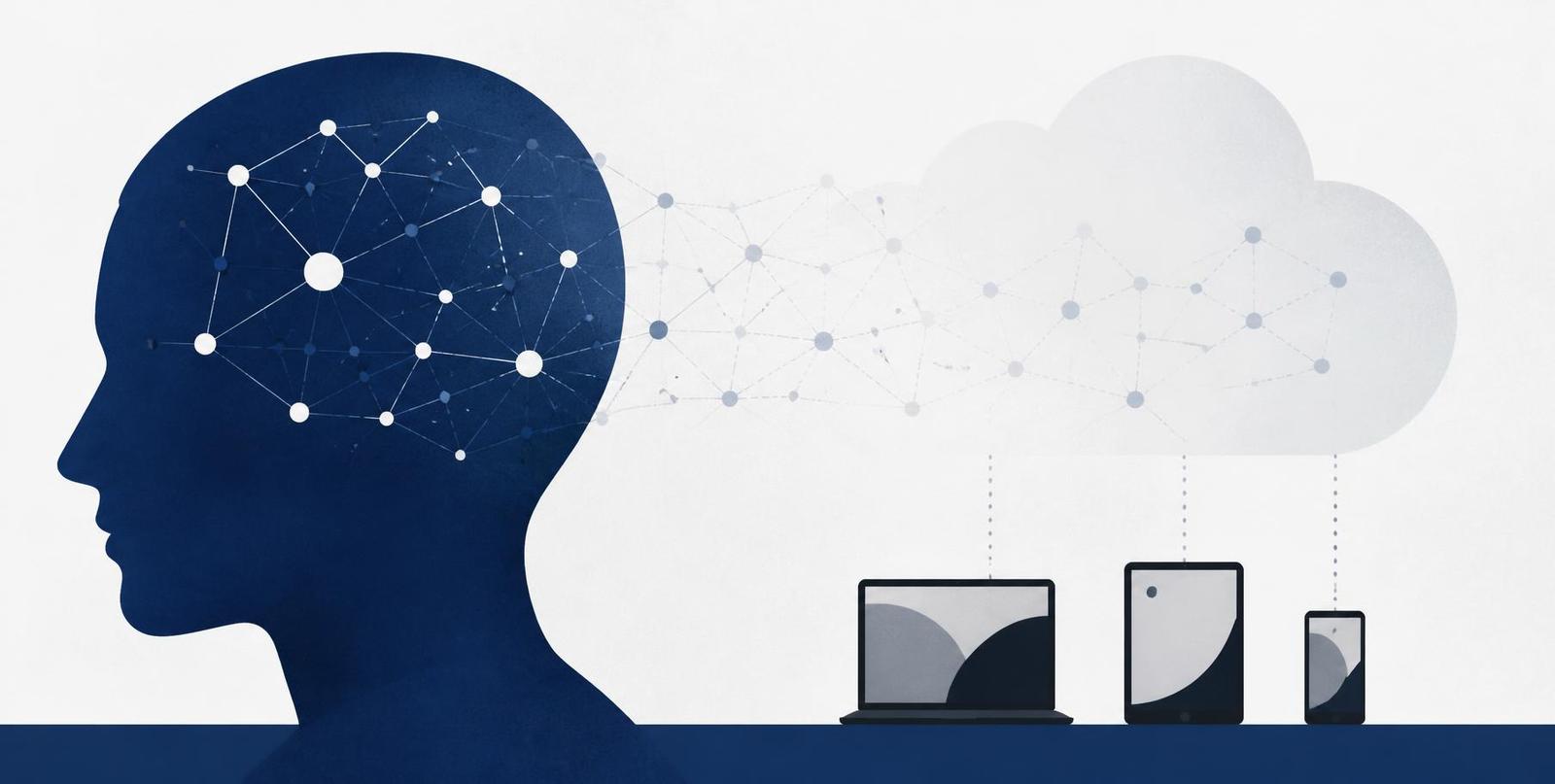
Digital amnesia is not a clinical condition. The phrase was coined in a 2015 marketing report by an antivirus company, not in a journal. The most-quoted experiment behind it did not reproduce in two better-powered attempts. What does hold up is narrower: you remember less of what you trust a system to store.
“Digital amnesia” reads like a term from a laboratory. It has the shape of a diagnosis, the cadence of a research finding, and it gets repeated with the confidence of both. It came from neither. The research it is usually attached to points, in the parts that have survived scrutiny, somewhere more specific and less alarming than the phrase suggests.
That is worth knowing before you decide whether it describes you.
The phrase was born in a security vendor’s report, not a journal
The term entered general circulation with The Rise and Impact of Digital Amnesia, published by Kaspersky Lab in 2015 (Kaspersky Lab 2015). It is not a study. It is a commissioned consumer survey, carried out by the research agency Opinion Matters, with fieldwork conducted in May 2015.
There are two versions of it, and they are routinely conflated. The US version surveyed 1,000 respondents. The European version surveyed 6,000, made up of 1,000 respondents in each of six markets. Statistics from one are quoted as though they came from the other. If you see a “digital amnesia” figure quoted without a country and a sample attached, the person quoting it does not know which document they are citing.
Two further things about the report matter. Academic commentary was attached to it, and commentary attached to a marketing report is not peer review; nothing in that document went through the process the word “study” implies. And the report’s own headline statistics include findings about device security, which is the tell. The document that gave the world the phrase was published by a company that sells security software, and it argues, among other things, that people do not protect their devices well enough.
None of that makes the survey dishonest. It makes it marketing. A phrase that originates in marketing can still turn out to describe something real, so the next question is what the underlying science says.
The most-quoted experiment behind the phrase did not reproduce in two better-powered attempts
The research usually invoked to give “digital amnesia” scientific weight is Sparrow, Liu and Wegner’s 2011 paper in Science, the source of what is popularly called the Google effect (Sparrow et al. 2011). It contained four experiments. They are not all in the same condition, and the flashiest one is in the worst shape.
Experiment 1 was a modified Stroop task built to test whether being asked hard trivia questions makes computer-related words harder to ignore, a result often summarised as evidence that difficulty makes people think of search engines. That is the experiment two later attempts did not reproduce. It was tested by the Social Sciences Replication Project, a large preregistered replication effort, and reported in Nature Human Behaviour (Camerer et al. 2018). This was the Social Sciences Replication Project, not Many Labs; the two are frequently confused in write-ups of this literature. The project used a two-stage design with far more participants than the original: stage one with n = 104 returned p = 0.2647, and stage two, pooled to n = 234, returned p = 0.4493. Neither stage supported the original result.
An independent replication by Hesselmann, published in PeerJ with N = 89, reached the same place by a different route (Hesselmann 2020). Its Bayes factor of BF01 = 5.07 means the data were roughly five times more likely under the hypothesis of no effect than under the hypothesis of an effect, which is to say that the reported Bayes factor favoured the null model under the study’s specified analysis.
There is also a problem with the original’s own numbers. The sample size of Experiment 1 is genuinely disputed in the literature: the supplementary materials give 46, while the main text implies 69. Hesselmann documents the discrepancy. Anyone who cites a single confident figure for that experiment is citing one of two incompatible numbers without saying so, and this article will not do it either.
The part that does reproduce only reproduces under one condition
A different experiment in the same 2011 paper has held up better, and it is the one that matters. Experiment 2, with 60 participants, tested whether people remember information less well when they believe it has been saved for them.
That effect does reproduce in the retrieved studies, but with a boundary condition that changes what it means. Schooler and Storm, across two experiments published in Memory in 2021, found that it appears when the saving system is perceived as reliable and disappears when the saving system is perceived as unreliable (Schooler and Storm 2021). The memory difference is not produced by the act of typing something into a machine. It is produced by trusting the machine. Take the trust away and the difference goes with it.
That is a description of a mind allocating effort according to what it expects to need, not a mind losing capacity.
The related finding, that people remember where information is stored better than they remember the information itself, comes from Experiments 3 and 4 of the same paper, with 28 and 32 participants (Sparrow et al. 2011). Those are very small samples, and the documented retrieval for this dossier, dated 4 September 2026, did not locate a direct replication of either. Treat it as suggestive and no more.
Offloading trades memory for the saved item against capacity for what comes next
The phrase “digital amnesia” carries an implied claim: that handing information to a device erodes memory in general. The research on cognitive offloading does not support that, and it does not support the opposite blanket claim either. Two things are true at once, and flattening them into one is how this subject usually goes wrong.
The first is the trust effect above. Information you believe is safely stored is remembered less well than information you believe is not. That is a real cost, and it applies to the material that was offloaded.
The second is what the offloading buys. Storm and Stone, across three experiments in Psychological Science, found that saving one set of information can improve memory for the next set (Storm and Stone 2015). Offloading the first thing freed capacity for the second. Their per-experiment sample sizes could not be verified for this article, so no sample size is printed for that study and the result should be weighed accordingly.
The theoretical review by Risko and Gilbert in Trends in Cognitive Sciences describes the pattern more broadly: offloading is strategic, a reallocation of effort that people modulate according to how much they trust the external store and how costly remembering would be (Risko and Gilbert 2016). It is closer to writing a shopping list than to losing a faculty, and like a shopping list it costs you the memory of the items and buys you the attention to do something else.
This is where the phrase and the science part company. The phrase says amnesia, and amnesia is a loss with nothing on the other side of it. Nothing in the retrieved studies shows that search engines or cloud storage damage memory in general. That claim is not established, and this article does not make it.
It is not a diagnosis
“Digital amnesia” is not recognised as a diagnosis in DSM-5-TR or ICD-11. Neither classification includes any such condition, so there is no diagnosis to have and no threshold to meet.
A small research literature has grown up around the phrase since it was coined. It is recent, and the documented retrieval for this dossier, dated 4 September 2026, found it dominated by cross-sectional self-report work and scale development, which is to say by questionnaires that measure what people believe about their own memory rather than what their memory does. That is a real limit on what any of it can establish.
Much of the research literature describes the same underlying behaviour as cognitive offloading. The vocabulary difference is doing work: one term describes a strategy with costs and benefits, the other describes a disease. Run those together and you get the phrase: a clinical category that does not contain it, a marketing term that does, and a measured behaviour that is neither.
What to do with the phrase
Use it as a search term, not as a description of yourself.
If someone quotes a “digital amnesia” statistic, ask which of the two 2015 surveys it came from and which country. If someone cites the Google effect as proof that search engines are hollowing out memory, the most-quoted experiment behind it did not reproduce in two better-powered attempts, and the experiment that did survive only survives when the person trusts the system doing the saving.
What is left, once the marketing is separated out, is a genuinely interesting finding about trust: you remember less of what you believe is safely stored, and you remember more of it again as soon as you stop believing that. That is a fact about confidence, not about capacity, and it is more useful than the phrase it has been sold under. If you want the same question applied to what happens when a machine does the thinking rather than the storing, that is the subject of using AI without outsourcing the thinking.
The mechanism itself, and what the wider memory and learning research shows, is set out in the cognitive offloading guide.
We trace claims like this one back to the document that started them, and publish what we find. The Weekly System has not launched yet. You can join the launch list.


Human Operating System
Human Operating System is a research-led publication about the human mind under digital pressure. We report what the evidence does - and does not - support.
About Human Operating SystemSources & Further Reading
10 sourcesThese are the sources used for this article. Where a study's limits matter to the claim, those limits are kept in the citation.
View all 10 sourcesHide sources
- Camerer, C. F., Dreber, A., Holzmeister, F., et al. (2018). Evaluating the replicability of social science experiments in Nature and Science between 2010 and 2015. Nature Human Behaviour, 2, 637–644. Open source ↗
- Hesselmann, G. (2020). No conclusive evidence that difficult general knowledge questions cause a “Google Stroop effect”. A replication study. PeerJ, 8, e10325. Open source ↗
- Kaspersky Lab (2015). The Rise and Impact of Digital Amnesia. Commissioned consumer survey conducted by Opinion Matters, fieldwork May 2015. US version N = 1,000; European version N = 6,000, 1,000 in each of six markets. Open source ↗
- Risko, E. F., & Gilbert, S. J. (2016). Cognitive offloading. Trends in Cognitive Sciences, 20(9), 676–688. Open source ↗
- Schooler, J. N., & Storm, B. C. (2021). Saved information is remembered less well than deleted information, if the saving process is perceived as reliable. Memory, 29(9), 1101–1110. Open source ↗
- Sparrow, B., Liu, J., & Wegner, D. M. (2011). Google effects on memory: Cognitive consequences of having information at our fingertips. Science, 333(6043), 776–778. Open source ↗
- Storm, B. C., & Stone, S. M. (2015). Saving-enhanced memory: The benefits of saving on the learning and remembering of new information. Psychological Science, 26(2), 182–188. Open source ↗
- World Health Organization. Terminology: disorders due to addictive behaviours. Open source ↗
- Diagnostic and Statistical Manual of Mental Disorders, Fifth Edition, Text Revision (DSM-5-TR), checked for the term “digital amnesia”.
- Documented retrieval for this dossier, 4 September 2026: PubMed search for the exact phrase “digital amnesia”. Open source ↗
The Weekly System
Join the launch list for one calm, research-led email about attention, memory, learning and the systems designed to hold your attention. No noise, no panic and no unsupported certainty.