
Distracted Walking: Large in the Simulator, Very Small in the Crash Data
Phone distraction produces measurable crossing errors in simulators. In fatality records, it appears in only a fraction of one per cent of cases.
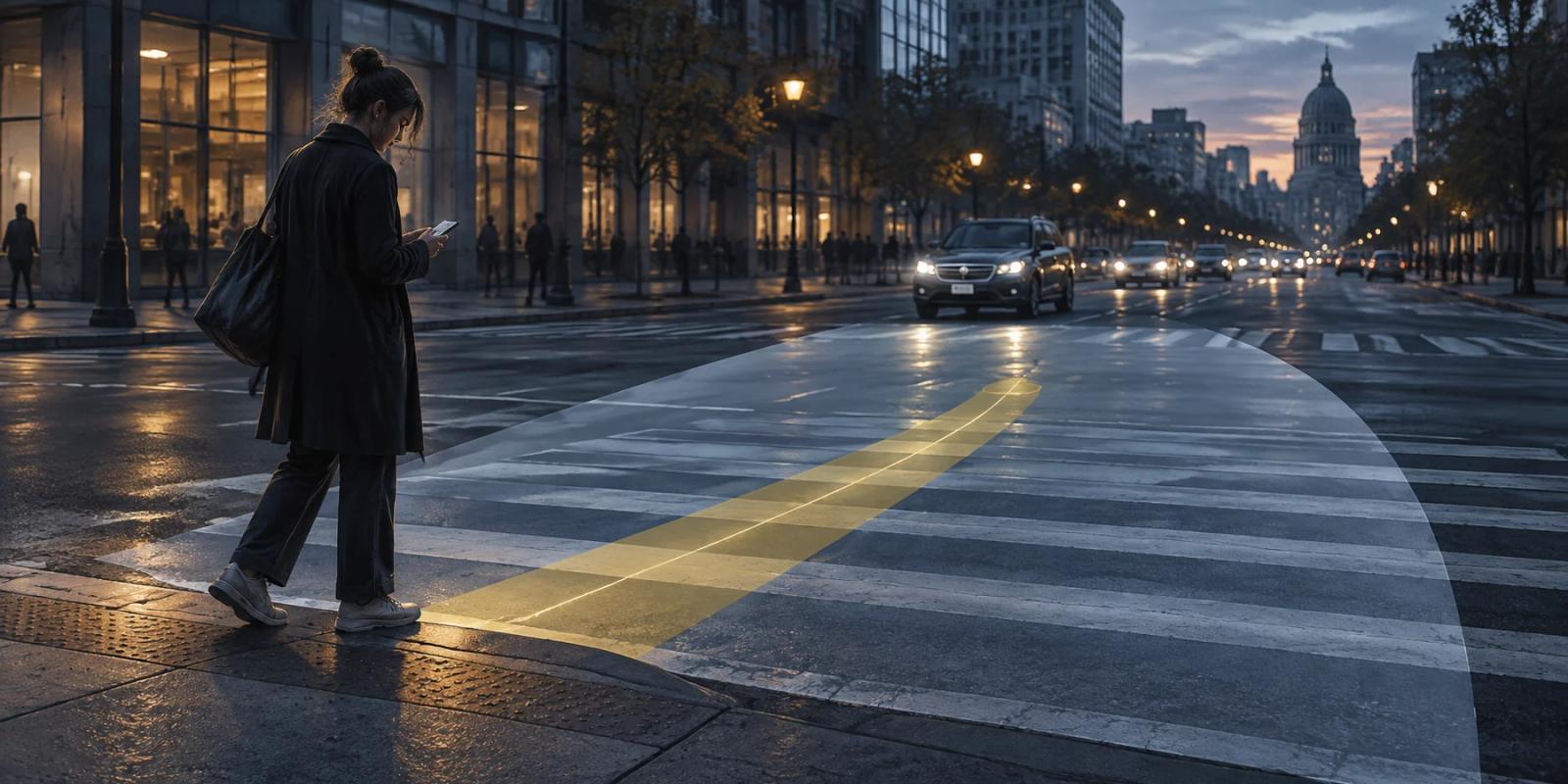
This is one of the cleanest examples in this whole field of a real laboratory effect and a very small population effect, and of what happens when the first gets legislated as though it were the second.
The laboratory finding is genuine. Put people in a virtual street and give them a phone, and their crossing behaviour deteriorates measurably.
The crash data says something else. When transport agencies go looking for phone use in actual pedestrian fatality records, they find it in a fraction of one per cent of cases.
Both things are true. The article is about how they fit together.
What the simulators found
Simmons and colleagues (2020), in Injury Prevention, ran the meta-analysis. Thirty-three studies met inclusion criteria; fourteen experimental studies were meta-analysed across 81 effect sizes, with eight observational studies handled qualitatively.
The pooled effects, as correlations:
| Outcome | Phone conversation | Texting | Music |
|---|---|---|---|
| Hits and close calls | 0.17 [0.12, 0.22], k=10 | 0.34 [0.23, 0.46], k=4 | 0.18 [−0.12, 0.49], k=4 |
| Looking left and right | −0.14 [−0.36, 0.08], k=11 | −0.43 [−0.67, −0.19], k=5 | 0.05 [−0.09, 0.20], k=6 |
| Time to start crossing | 0.25 [0.14, 0.35], k=9 | 0.32 [0.16, 0.49], k=5 | 0.09 [−0.09, 0.26], k=5 |
| Crossing duration | 0.14 [−0.02, 0.30], k=6 | 0.01 [−0.19, 0.21], k=3 | — |
Texting is consistently the worst of the three. Music does not reach significance on any pooled outcome — note that, because it contradicts one of the most-quoted individual studies below.
Byington and Schwebel (2013) ran 92 participants through a virtual street, within-subjects, twenty crossings each — ten undistracted, ten texting. Every safety outcome moved: hits and close calls from 0.56 to 1.35, F(1,90) = 29.54; missed safe crossing opportunities from 1.72 to 4.63, F(1,90) = 42.63; looks at traffic from 35.86 to 25.69 per minute, F(1,89) = 124.68; all p < 0.01.
There is a number from this study that circulates without its meaning attached, and we want to handle it carefully rather than repeat it. The study reports a partial eta squared of .96 — an effect size so large it looks like a headline. It attaches to percentage of time with eyes off the road: 0.69% undistracted against 59.75% while texting.
That is a manipulation check. It confirms that people looking at a phone are looking at a phone. It is not a measure of injury risk, and printing it next to a safety claim would misrepresent the study badly.
The study that does not say what it is quoted as saying
Schwebel and colleagues (2012), in Accident Analysis & Prevention, is the most cited single experiment here, with 138 participants in four independent groups of roughly 30 to 34.
Its hit rates by condition:
| Condition | Hit rate | Odds ratio vs undistracted |
|---|---|---|
| Undistracted | 6% | — |
| Phone conversation | 12% | 2.00 [0.34, 11.79], not significant |
| Texting | 25% | 5.27 [1.02, 27.33], p < .05 |
| Music | 32% | 7.91 [1.60, 39.03], p < .05 |
Two results here run against the public story. Music produced the highest hit rate in the study — higher than texting. And talking on the phone was not statistically significant, which is the behaviour most distracted-walking campaigns are built around.
Now look at those confidence intervals. The music odds ratio runs from 1.60 to 39.03. That is what a between-subjects design with about 34 people per cell buys you. And when Simmons and colleagues pooled music across four studies, the effect was r = 0.18 [−0.12, 0.49] — null.
So the vivid 32% does not survive meta-analysis. We are printing it because it is real and because the phone-conversation null is important, not because music is dangerous.
Note also that Schwebel is senior author on both of the experimental studies above, both using the same virtual pedestrian environment at the same university. That is one laboratory and one apparatus, not two independent lines of evidence.
What the crash records show
This is where the article turns, and the sources here are transport agencies rather than psychologists.
New York City’s Department of Transportation examined pedestrian fatality reports and found electronic distraction recorded in 0.2% of cases — two out of 856 narratives between 2014 and 2017. Nationally, across 2010 to 2015, it put device-related pedestrian fatalities at 0% to 0.2%. Its conclusion: “it appears that distracted walking is a very minor contributor to pedestrian death and injury.” New York State’s records over the same period showed devices involved in two instances.
NHTSA, reviewing the evidence in 2016, was blunter about what the science can carry: “There are no studies showing a direct link between the behavioral effects of distraction and pedestrian crash risk.” On the emergency-department data that produces most media headlines, it noted the database “is useful, but lacks prevalence data to use in normalizing” — meaning you can count injuries but cannot compute a rate. And on retrospective injury data generally: it “can quantify the consequences of distraction, but don’t tell us anything about exposure or risk.”
That last sentence is the whole methodological problem. Phone use among pedestrians rose enormously over the period in question. Without knowing how many phone-using pedestrian-hours there were, a rising count of phone-related injuries tells you very little.
The laws, and the absence of evaluation
Several places have legislated. Almost nobody has checked whether it worked.
Honolulu enacted an ordinance in 2017 prohibiting crossing while viewing a mobile electronic device. As of November 2019, 232 people had been cited. The legal literature reviewing it records that the ordinance “appears to have had no effect on pedestrian deaths and injuries.” Rexburg, Idaho (2011) and Montclair, California (2017) passed similar measures; bills failed in New York, Connecticut and New Jersey.
Arafat, Larue and Dehkordi (2023) reviewed 42 articles on interventions for phone-distracted pedestrians in the Journal of Safety Research. Their findings: “Legislative approaches and educational campaigns lacked formal evaluation,” infrastructure warnings “frequently triggered false alerts,” and “more work is required to identify the most effective interventions to implement.”
The pavement-embedded traffic lights installed in Bodegraven, Augsburg and Seoul are widely reported and, as far as we could establish, never evaluated in the published literature. We searched for outcome studies and found news coverage only.
The argument that the framing is the problem
Ralph and Girardeau (2020), in Transportation Research Interdisciplinary Perspectives, surveyed transportation professionals about pedestrian safety. They found that roughly a third viewed distracted walking as a significant concern, and that the professionals holding that view estimated it accounted for a substantially larger share of pedestrian fatalities than the crash records support. Concern was higher among those who primarily drive. Which framing a professional held predicted which policy they preferred — education aimed at pedestrians, or reductions in vehicle speed.
This is a survey of professional belief, not of crash causation, and should be read as such. But given what the fatality records show, it is not a dissent to be balanced against the evidence. On the injury data, it is closer to being right.
What this leaves you with
The laboratory effect is real and you should take it personally. Texting while crossing measurably degrades how much you look and how often you step into danger, and the meta-analysis backs that up. If you are about to cross a road, put the phone down. That is a good idea supported by evidence.
The population claim is not supported. “Distracted walking is killing pedestrians” is not what the fatality records show, and the agency that would most like to have that data says the link has not been demonstrated.
Be sceptical of injury counts without denominators. A rising number of phone-related pedestrian injuries during a period when phone use rose enormously is close to uninformative about risk.
Nothing here is a claim about what any city should do, and no road-safety recommendation appears in this article. The evidence supports a statement about individual behaviour on one hand and an absence of population evidence on the other. It does not reach as far as policy.
For what phone presence does to attention more broadly, see check your phone less. For the interruption research and what it will and will not carry, see what notifications actually do. For the wider picture, see the screens, attention and focus guide.
Limitations of this article
Every experimental effect here comes from simulators and virtual environments. No study in the meta-analysis measured a real collision.
Two of the three experimental sources are one laboratory. Schwebel is senior author on both, using the same apparatus.
We did not print a widely circulated figure — an emergency-department count of mobile-phone-related pedestrian injuries often attributed to a particular study year — because we could not verify the year, the count and the denominator together from the paper itself. See the withheld-figures record.
We could not retrieve the funding statement for the Simmons meta-analysis.
We read the Simmons pooled effect sizes in a repository copy rather than the publisher version of record. That is disclosed in the source-resolution record.

Human Operating System
Human Operating System is a research-led publication about the human mind under digital pressure. We report what the evidence does - and does not - support.
About Human Operating SystemSources & Further Reading
8 sourcesThese are the sources used for this article. Where a study's limits matter to the claim, those limits are kept in the citation.
View all 8 sourcesHide sources
- Simmons, S. M., Caird, J. K., Ta, A., Sterzer, F., & Hagel, B. E. (2020). Plight of the distracted pedestrian: A research synthesis and meta-analysis of mobile phone use on crossing behaviour. Injury Prevention, 26(2), 170–176. Open source ↗
- Schwebel, D. C., Stavrinos, D., Byington, K. W., Davis, T., O’Neal, E. E., & de Jong, D. (2012). Distraction and pedestrian safety: How talking on the phone, texting, and listening to music impact crossing the street. Accident Analysis & Prevention, 45, 266–271. Open source ↗
- Byington, K. W., & Schwebel, D. C. (2013). Effects of mobile Internet use on college student pedestrian injury risk. Accident Analysis & Prevention, 51, 78–83. Open source ↗
- New York City Department of Transportation. (2019). Distraction Shouldn’t Be Deadly. Open source ↗
- Scopatz, R. A., & Zhou, Y. (2016). Effect of Electronic Device Use on Pedestrian Safety: A Literature Review. Report No. DOT HS 812 256. National Highway Traffic Safety Administration. Open source ↗
- Arafat, M. E., Larue, G. S., & Dehkordi, S. G. (2023). Effectiveness of interventions for mobile phone distracted pedestrians: A systematic review. Journal of Safety Research, 84, 330–346. Open source ↗
- Ralph, K., & Girardeau, I. (2020). Distracted by “distracted pedestrians”? Transportation Research Interdisciplinary Perspectives, 5, 100118. Open source ↗
- Smith, M. L. (2022). Distracted walking. Penn State Law Review, 126(3), 683–730. Open source ↗
The Weekly System
Join the launch list for one calm, research-led email about attention, memory, learning and the systems designed to hold your attention. No noise, no panic and no unsupported certainty.