
How to set screen rules that actually work
Screen rules fail because families treat them as commands issued in the moment, not as household infrastructure. A rule that bends with your energy teaches your child the rule is your mood. Here is how to build screen rules that hold.
You did it properly. You gathered everyone on Sunday, you talked it through, you wrote the rules down, maybe you even made a chart. Everyone agreed.
By Wednesday the agreement had quietly evaporated, and by the weekend you were back to negotiating every single screen from scratch, wondering why you cannot make one simple rule hold in your own home.
Here is the part worth hearing first: this almost never means your child is uniquely defiant, and it almost never means you lack authority. Screen rules collapse for a specific, fixable reason, and it has more to do with how the rule is built than with how strict you are.
The real reason screen rules collapse
Most families treat a screen rule as a command-something you issue, in the moment, each time it comes up. "Off now." "That's enough." "Last one."
A command has to be re-issued every single time, which means every single time is a fresh decision, and every fresh decision can be argued with. You are not enforcing a rule so much as re-litigating one, forty times a day, usually when you are tired.
The deeper problem is what your enforcement teaches when it wavers. Say the no-screens-at-dinner rule holds on Monday, but by Friday you are exhausted and let it slide. Your child learns something exact from that: the rule is not really fixed, it tracks your energy.
And once a child has worked out that a rule rises and falls with your mood, every rule becomes a probe-they are not defying you, they are testing to find out what kind of day it is. A rule that changes with the adult's mood has, in effect, taught the child that the rule is the adult's mood.
Notice that neither failure is about your family lacking discipline. They are about where the rule lives. When a rule lives in your moment-to-moment energy, it is only ever as steady as you are on your worst evening. The fix is to move it somewhere steadier.
Move the rule from your mood into the household
The most useful shift you can make is to stop thinking of screen rules as instructions you give and start thinking of them as infrastructure the house runs on. Infrastructure does not depend on anyone's mood. The water comes out of the tap whether or not you feel like it today.
Good screen rules work the same way: they are simply how this household operates, every day, independent of how much patience you have left at 7pm.
That is why the strongest rules are not the strictest ones. They are the ones that no longer require a decision in the moment, because the decision was made once, in advance, by everyone, and now it just holds.
A rule you have to summon willpower to enforce is a rule still living in your mood. A rule that holds on your worst night has genuinely moved into the household.
What the guidance actually says now
It helps to know that the official advice has shifted, because many parents are still chasing a number the experts themselves have stepped back from.
For years, "two hours a day" circulated as the magic ceiling. The American Academy of Pediatrics has since moved away from a single blanket hour limit for older children and teenagers, because the evidence for one universal number is not there.
In its place they point parents to a personalised Family Media Plan and a short framework they call the 5 Cs: Child, Content, Calm, Crowding Out, and Communication. In plainer words: who your child is, what they are actually watching, whether screens are helping or hurting their mood, whether screens are crowding out sleep and play and family time, and whether you are talking about any of it. Quality and context, not only a stopwatch.
For the youngest children the guidance is still specific and worth stating plainly. The World Health Organization recommends no screen time for children under one, and no more than one hour a day, less being better, for ages two to four.
Under - fives are the one group where a firm number still stands. For everyone older, the honest answer is that the right amount depends on the child and on what the screen is displacing.
One caveat, because HOS does not oversell research: the studies underneath all of this are largely correlational. They describe tendencies across groups, not a guarantee for your particular child. Treat them as a reliable compass, not a law.
How to build rules that hold
So how do you move a rule out of your mood and into the household? Three principles.
Build them together, out loud
Sit down as a family and write the rules with your kids in the conversation, not as an audience to it. Let them argue a point, shape a detail, win a small concession. A rule a child helped design is one they own a sliver of, and people defend what they have a stake in.
Write rules about the arrangement, not the moment
This is the heart of it. Do not write rules that force you to referee every individual screen. Write rules about where devices live and when they are away.
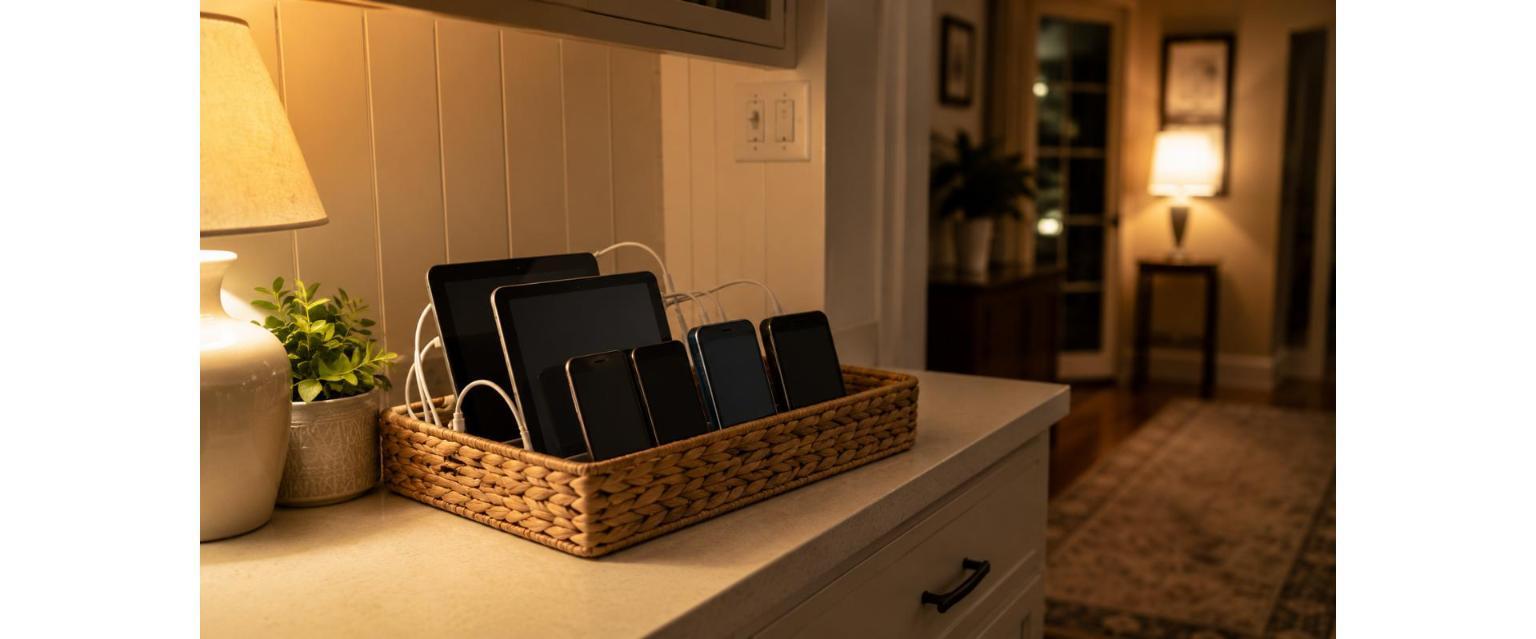
Phones and tablets charge in a shared space overnight. Screens are gone at meals. Nothing on the screen in the last hour before bed. These do not need a decision in the moment, because the moment was already decided.
Make the core rules apply to the adults
Families skip this one most often, and it is the one that gives a rule its authority. If phones - away - at - dinner binds the children but not you, your children learn the rule is about power, and they will drop it the instant they can.
If it binds everyone, it becomes a shared household value rather than a punishment aimed downward. You do not have to be flawless. You do have to be in it with them.
The four rules that carry most of the weight
You do not need fifteen rules. You need three or four good ones covering the moments that matter most. For most families, these do the heavy lifting.
Devices sleep outside the bedroom. Phones and tablets charge in a shared space overnight, not by the bed. This rule targets the bedroom specifically rather than relying only on a general screen-time limit. For households managing several devices, a charging station with separate slots can make that shared space easier to organise. This is an optional setup aid, not a requirement for the rule to work.
Screens are away at meals, for everyone. Meals are where a family actually talks, and one phone on the table quietly ends that.
Nothing on the screen in the last hour before bed. Late screens make winding down harder and make it easy to lose an hour without noticing.
One agreed weekday window, decided together. Not policed to the minute, but a shared understanding of roughly when and how much on school nights.
Four rules, all about the arrangement, all binding on the whole household. That is a set a family can genuinely live by.
Expect the test, and hold steady
Even good rules wobble at first, because testing is how children find out whether a rule is real. The first week or two is not the rule failing-it is the rule being checked. This is exactly why steadiness matters so much: the calm, unremarkable, every-day holding of the rule is what proves it is infrastructure and not a mood.
So decide in advance, while everyone is calm, what happens when a rule is broken, and keep it small and predictable rather than a dramatic penalty invented mid-argument. A known, minor, consistent consequence outperforms a big unpredictable one every time.
Then hold the line quietly for a couple of weeks. Most families find that the thing they fought about daily has, by the end of that stretch, largely stopped being a fight - not because the children changed, but because the rule finally moved out of the parent's mood and into the house. If the rules need enforcing on the device itself, our comparison of parental control apps for different family setups shows which tools close which gap.

Human Operating System
Human Operating System is a research-led publication about the human mind under digital pressure. We report what the evidence does - and does not - support.
About Human Operating SystemSources & Further Reading
8 sourcesThese are the sources used for this article. Where a study's limits matter to the claim, those limits are kept in the citation.
View all 8 sourcesHide sources
- American Academy of Pediatrics. Family Media Plan and the 5 Cs of Media Use. healthychildren.org /
- aap.org (2025-2026).
- World Health Organization (2019). Guidelines on physical activity, sedentary behaviour and sleep for
- children under 5 years of age.
- Bjelland, M. et al. (2015). Associations between parental rules, style of communication and children's
- screen time. BMC Public Health, 15:1002.
- Collier, K. M. et al. (2016). Does parental mediation of media influence child outcomes? A meta-analysis.
- Developmental Psychology, 52(5).
The Weekly System
Join the launch list for one calm, research-led email about attention, memory, learning and the systems designed to hold your attention. No noise, no panic and no unsupported certainty.