
What to do when your kid won't get off Roblox
Roblox is hard to leave because many experiences have no built - in ending, are social in real time, and make progress feel live. The article argues that parents can reduce nightly standoffs by building a clearer exit instead of treating the moment as defiance.
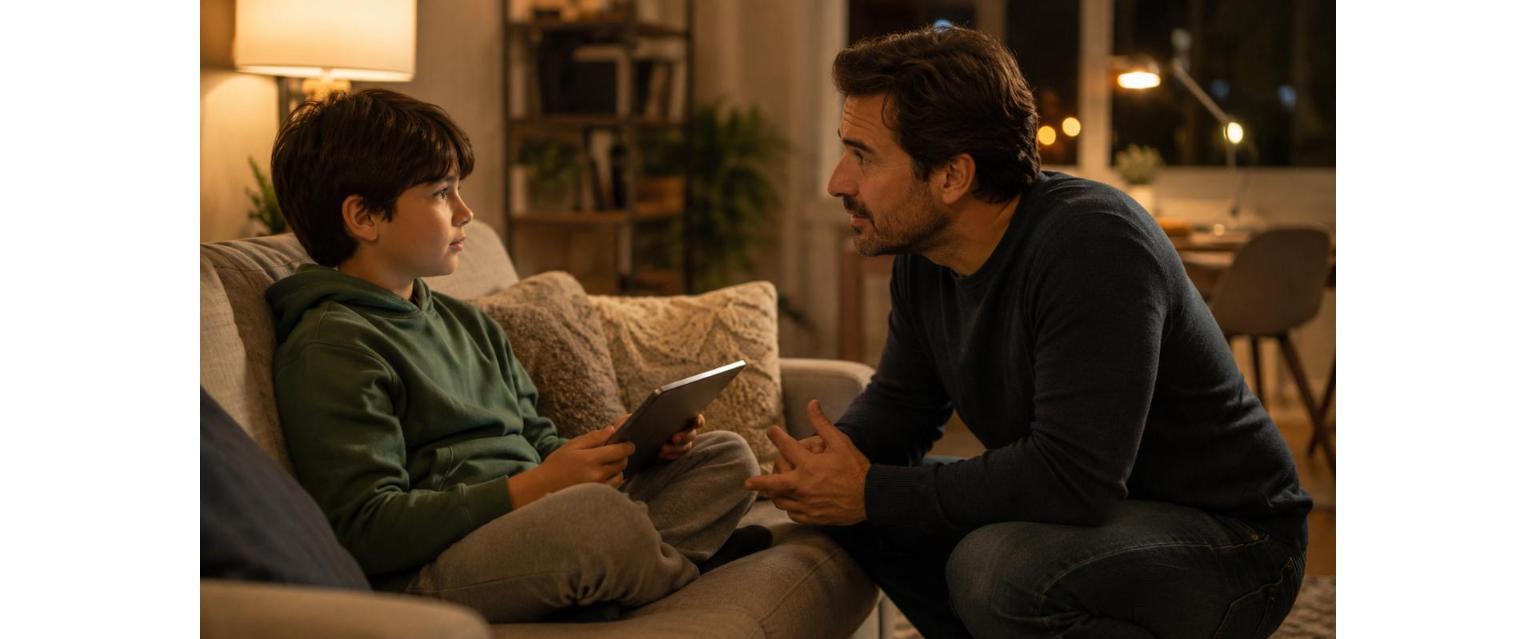
You gave the warning. Twenty minutes, you said, and they nodded.
Twenty minutes later you called time, and instead of "okay" you got tears, panic, "you don't understand, I can't just leave right now," and a standoff that turned a simple bedtime into a ninety - minute war.
You walked away feeling like the bad guy for enforcing a rule you thought you had both agreed to.
If that is most of your evenings, start here: this is a design problem, not a discipline problem. Your child is not being unreasonable, and you are not failing.
Roblox is genuinely hard to leave, for reasons built into how it works, and once you understand those reasons you can solve the standoff with engineering instead of force.
The reason it turns into a war
Most parents file this under "my kid won't get off." But watch the moment closely and it is less a refusal than a child being pulled out of something that has no clean way to end, while other people are still inside it.
That distinction decides your whole approach. Treat it as defiance and you fight your child every night.
Treat it as a missing exit and you build one, which is calmer for everyone and actually works.
Three design facts that make Roblox so sticky
Roblox is not one game with a finish line. It is a platform hosting millions of games - it calls them experiences - almost all made by other users.
That structure creates three specific features that make leaving hard, and it is worth knowing all three, because each one needs a different countermove.
There is no built - in ending
A jigsaw finishes. A match finishes. A level finishes.
Most Roblox experiences simply continue, so "get off when you're done" never arrives, because done never comes.
When you call time, you are interrupting something that was going to keep going, at a point that feels arbitrary from your child's seat.
It is social
This is the big one. Your child is usually not playing alone - their friends are in the game at that exact moment.
So "get off Roblox" does not feel like putting down a toy. It feels like walking out on the people they are in the middle of something with.
For most kids, the other people are the whole draw.
There is live progress on the line
A build in motion, a round underway, a team counting on them. Whether or not anything real is actually lost, the sense of abandoning something mid - flight is genuine, and it stings.
Put the three together and the meltdown reads differently. It is not a tantrum about screen time.
It is a child yanked out of an unfinished, social, live activity that offered them no way to bow out. Most adults would find that jarring too.
Skip the "addicted" label
In the heat of it, "addicted" is a tempting word. Leave it alone.
Labelling your child addicted converts a design problem into a verdict about who they are, and it moves you onto opposite sides.
What you are watching is an ordinary child responding in an ordinary way to an environment engineered to be engaging and built without an off - ramp.
Keep the responsibility on the design, where it belongs, and you stay on the same side as your kid, which is where you need to be for any of the following to work.
Build the exit the game refuses to provide
Because the real gap is a missing exit, your job is to install one. Three moves do most of it.
Warn in the game's own units, not just the clock
"Twenty minutes" means little inside a world with no clock. "Finish this round and then we're done," or "one more build and that's it," speaks the game's language and hands your child a real, reachable finish line - the ending the experience declines to give them.
Give the warning, then a shorter reminder near the end, then hold it.
Give them somewhere to arrive
A child told to get off Roblox is being asked to leave a bright, social, active world for, usually, nothing. Of course they dig in.
Leaving is far easier when there is something to move toward - dinner genuinely on the table, a show you will watch together, a walk, a game with you.
Frame the transition as "from this to that," and line up the "that" before you ever call time.
Let a routine do the work a confrontation cannot
Bedtime works on good nights because it is the same every night and the body sees it coming. Give the Roblox exit the same shape: same warning, same landing spot, same order, daily.
Predictability is what turns leaving from a shock into a habit. The first week will still wobble - hold it calmly and it settles down.
Let the built - in timer end the session
Here is the move many parents do not realise they have: you do not have to be the one who pulls the plug.
Roblox's own parental controls let you set a daily screen - time limit, and when your child reaches it, the app itself closes access. That changes the emotional shape of the moment entirely.
When you announce that time is up, you are cast as the villain. When a neutral timer announces it, you get to stand beside your child instead - "I know, the timer's done, that's genuinely annoying, come on, let's go do the other thing."
To set it up, a parent links their own account to the child's and manages it from the parental - controls dashboard, where you can set daily time limits, cap spending, and control chat.
One important note, because Roblox has changed a great deal recently: through 2025 and 2026 it introduced age - based accounts - Roblox Kids for ages five to eight, Roblox Select for nine to fifteen - with different defaults, and expanded what parents can control.
Because these features move quickly, open Roblox's current parental controls and confirm the settings there rather than trusting any older walkthrough, including this one. Article 16 covers the full toolkit for gaming families, across consoles and phones as well.
The timer will not raise your child for you, and a determined kid can find edges. But paired with the warnings and the landing spot, it lifts the nightly enforcement off your shoulders and hands it to a clock nobody can argue with.
What reliably makes it worse
A few moves backfire, so name them plainly.
Do not cut it off mid - session with no warning
A surprise shutdown is the single most reliable trigger, because it drops your child out of a live, social moment with zero preparation. Whatever else you do, warn first.
Do not reopen the negotiation every night
If "five more minutes" is available on demand, your child will campaign for it daily. Set the arrangement once, calmly, and stop reopening it in the doorway.
Do not trade more screen time as the reward for ending screen time
It teaches the wrong lesson, and the loop never closes.
The version that works
You will not win this by being tougher at the doorway. You win by quietly removing the reasons the doorway is a battleground: give the game a real finish line, give your child somewhere to land, wrap it in a routine that repeats, and let Roblox's own timer carry the enforcement.
Do that, and within a couple of weeks the ninety - minute standoff usually shrinks to a grumble and a sigh - not because you got stricter, but because there is finally a clean way out.

Human Operating System
Human Operating System is a research-led publication about the human mind under digital pressure. We report what the evidence does - and does not - support.
About Human Operating SystemSources & Further Reading
6 sourcesThese are the sources used for this article. Where a study's limits matter to the claim, those limits are kept in the citation.
- Roblox Newsroom and Support - platform overview, experiences, parental controls, screen-time limits,
- age-based accounts. about.roblox.com / help.roblox.com (2025-2026).
- Internet Matters - Parents' guide to Roblox and how to keep kids safe. internetmatters.org.
- Common Sense Media - Parents' Ultimate Guide to Roblox; how to set parental controls on Roblox.
- commonsensemedia.org.
- American Academy of Pediatrics - Family Media Plan. healthychildren.org (2025-2026).
The Weekly System
The Weekly System has not launched yet. Join the launch list to hear when the first issue of this planned, research-led email is ready. No launch date or schedule has been announced.