
Why You Have Nowhere to Just Go Anymore: The Quiet Loss of Third Places
The quiet loss of third places, and how to rebuild one.
A free evening, and nowhere to go that is not home, work, or a place that wants your money. That is not just you. It is the quiet loss of third places. Here is what disappeared, and how to rebuild a version of it.
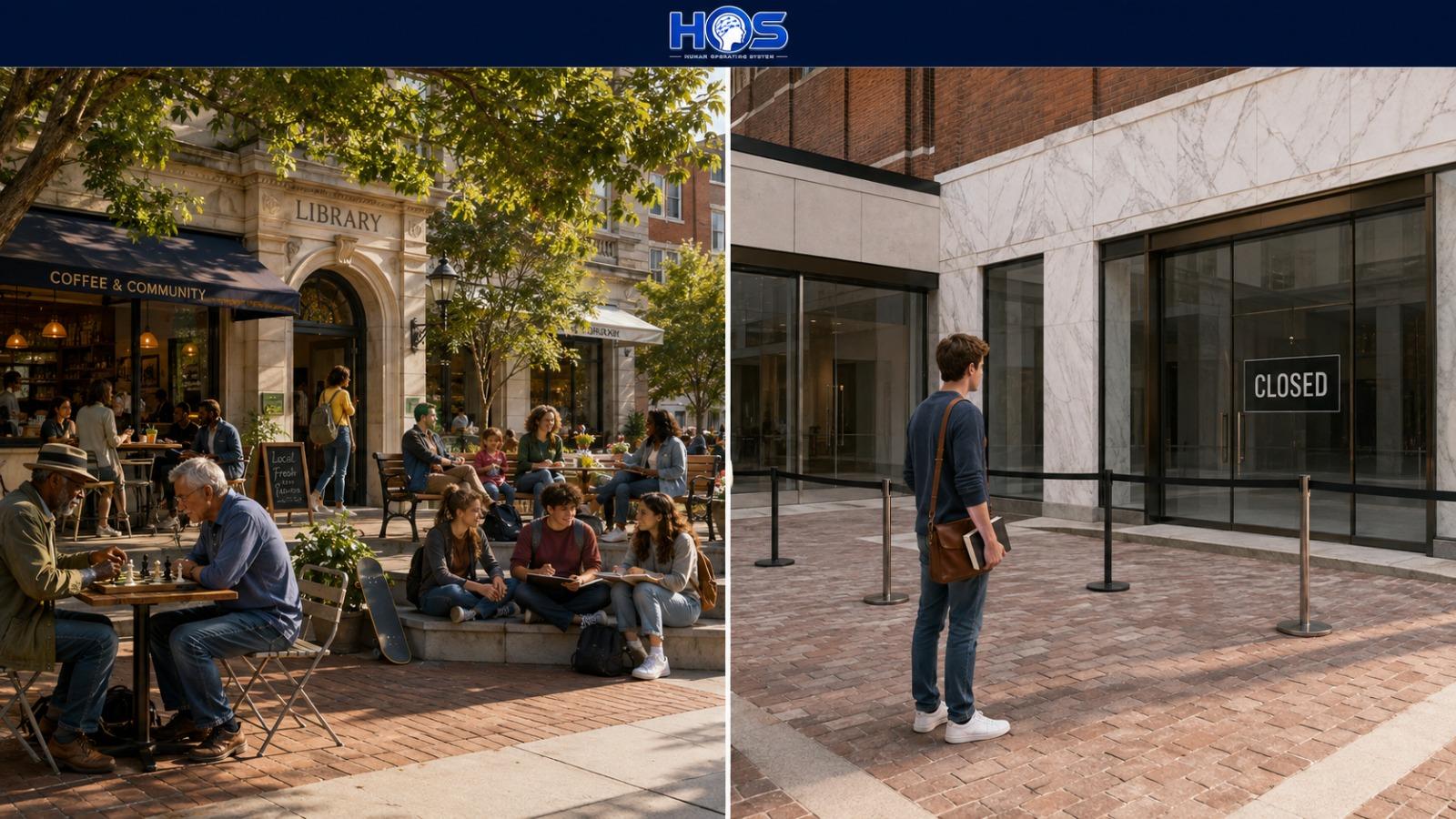
It is a free evening. You do not want to be at home, where there is laundry and the same four walls. You do not want to make a plan, book a table, or organize anything. You just want to be somewhere, around other people, with no agenda and no reason. And then it hits you: there is nowhere to go. Home, work, or somewhere that expects you to spend money to earn your chair. That is the whole list.
If that quiet realization is familiar, it is not a personal failing or a sign you have no friends. Something real has gone missing from ordinary life, and it has a name. What you are missing are third places. Once you can see the shape of the thing that vanished, the empty evening stops looking like your problem and starts looking like a structural one.
What are third places?
The name comes from the sociologist Ray Oldenburg. In his book The Great Good Place, he argued that a good life runs on three kinds of place. The first place is home. The second place is work. And the third place is everything else that used to hold a community together: the cafe, the pub, the library, the barbershop, the corner shop, the park bench, the place of worship. These are the informal, public, in-between spots where you go not to achieve anything but simply to be among people. You will also see them called third spaces. The two names point at the same thing.
What makes a real third place
Oldenburg described what separates a real one from a substitute, and the list is worth knowing, because it explains why so many modern stand-ins do not work. A third place sits on neutral ground, where you can come and go with no obligation and no one is host. It is a leveler, where your job title and income do not matter at the door. Its main activity is conversation. It is easy to reach and open often, so you can drop in alone and reliably find company. It has regulars who set a warm tone and absorb newcomers. It is unpretentious and plain. The mood is playful. And it works like a home away from home, a place where you belong without having earned it that day.
Read that list and you can feel what has thinned out. Most of us no longer have anywhere that ticks those boxes. It is not that the buildings are gone. It is that the ones still standing rarely work the way they used to.
What happened to third places
It is tempting to blame one villain, and there isn't one. Several ordinary forces quietly squeezed the third place out of daily life at once.
Many of the free, neutral spots became commercial, so the price of sitting somewhere became a purchase: a coffee to justify the table, a membership to justify the room. Towns spread out and became car dependent, so the walkable in-between places you could drift to were replaced by destinations you have to drive to on purpose. Time got tighter and more scheduled, so unstructured hanging around started to feel like a luxury or a waste. And a great deal of the easy, ambient contact that a third place used to provide migrated onto screens, which offer contact without the place, company you cannot actually sit inside.
None of those was a plot. Each made a kind of sense on its own. Together they hollowed out the middle and left most people with only the first place and the second, plus a vague sense that something in between used to exist. The lack of third spaces most people now feel is the sum of those ordinary pressures, not a single decision anyone made.
This is not only your experience. The political scientist Robert Putnam documented a broader version of it in Bowling Alone: across the second half of the twentieth century, Americans steadily withdrew from the shared, associational life of clubs, leagues, groups, and informal socializing that used to knit communities together. His exact weighting of the causes is his own estimate and has been debated, but the trend he traced is real and widely felt. We increasingly do things alone, or at home, or not at all.
Why two places are not enough
You can technically live in just two places. Plenty of people do. But a life that runs only between home and work has a specific cost, and it is worth naming plainly.
Home comes with its own duties and its own people, and work comes with its own demands and its own performance. Neither is a place where you can simply exist among others with nothing owed and nothing to prove. Third places were where easy, unplanned belonging happened: the low stakes, repeated, no agenda presence that turns strangers into familiar faces and familiar faces into something like community. Take that away and you do not just lose somewhere to sit. You lose the main way ordinary belonging used to build itself, quietly, over time, without anyone having to organize it. Community spaces were the social infrastructure that did that work, and most of us are now trying to build friendships without it. That absence is a lot of what the modern ache of loneliness actually is. Not too few people, but nowhere to be loosely among them.
What researchers say about third places and health
Researchers have started treating this as a public health question rather than a matter of taste. A 2019 paper in the journal Health and Place argued that their closure should worry us, because those spaces quietly do real work: buffering stress, easing isolation, offering low effort support and care. It is a framing more than a measured effect, and honesty matters here. No one has cleanly proven that losing them caused a specific rise in loneliness. But the argument is serious, and it fits what you feel on that empty evening.
How to find a third place near you
The good news is that this is not a grand project. It is a habit attached to a spot, and you can rebuild a version of one without any grand plan.
Begin by naming the candidates within about a fifteen minute reach of you. Examples of third places worth checking: a cafe, a library, a park, a gym, a place of worship, a community center, a bookshop, a bar. You are looking for somewhere you can go alone, comfortably, often, without spending much to justify being there. Some of the best options are simply places to hang out for free, which is not a downgrade but closer to the original idea. Then pick one and go regularly, ideally at the same rough time.
The regularity is the entire trick. A place you visit once is a location. A place you turn up to every Tuesday is on its way to becoming yours. The staff start to nod, a few faces become familiar, and belonging accrues without you having to force a single conversation.
Keep it low stakes on purpose. The value of a third place is that it asks nothing of you. You are not going to network, achieve, or make a best friend by Thursday. You are going to be present, among people, off the clock and off duty, and let the slow thing happen that only happens when the same humans keep ending up in the same warm room.
You are not imagining the emptiness of that free evening. A whole category of place slipped out of ordinary life. But third places are not gone for good. One gets rebuilt the way they were always built, by turning up somewhere unremarkable and then turning up again, until the place quietly becomes yours.
More on the shape of ordinary life in How We Live Now.
- Name what is missing: a third place, free of home's duties and work's demands.
- List the candidate spots within fifteen minutes of you.
- Pick one and go regularly, at the same time, so you become a regular rather than a visitor.
- Go without an agenda, and without spending as the price of entry where you can.
- Let it be low stakes. The point is easy presence, not a new project.
- Oldenburg, R. (1989/1999). The Great Good Place. Paragon House / Marlowe & Company.
- Putnam, R. D. (2000; revised 2020). Bowling Alone: The Collapse and Revival of American Community. Simon & Schuster.
- Finlay, J., Esposito, M., Kim, M. H., Gomez-Lopez, I. & Clarke, P. (2019). Closure of 'third places'? Exploring potential consequences for collective health and wellbeing. Health & Place, 60, 102225.

Human Operating System
Human Operating System is a research-led publication about the human mind under digital pressure. We report what the evidence does - and does not - support.
About Human Operating SystemThe Weekly System
Join the launch list for one calm, research-led email about attention, memory, learning and the systems designed to hold your attention. No noise, no panic and no unsupported certainty.