
Phubbing: What the Research Actually Found (and Who Invented the Word)
Phubbing was coined for a dictionary marketing campaign, then became a research field. The pooled effects are real but correlational, and the one dyadic study found perceived phone use predicted a worse day while actual phone use did not.
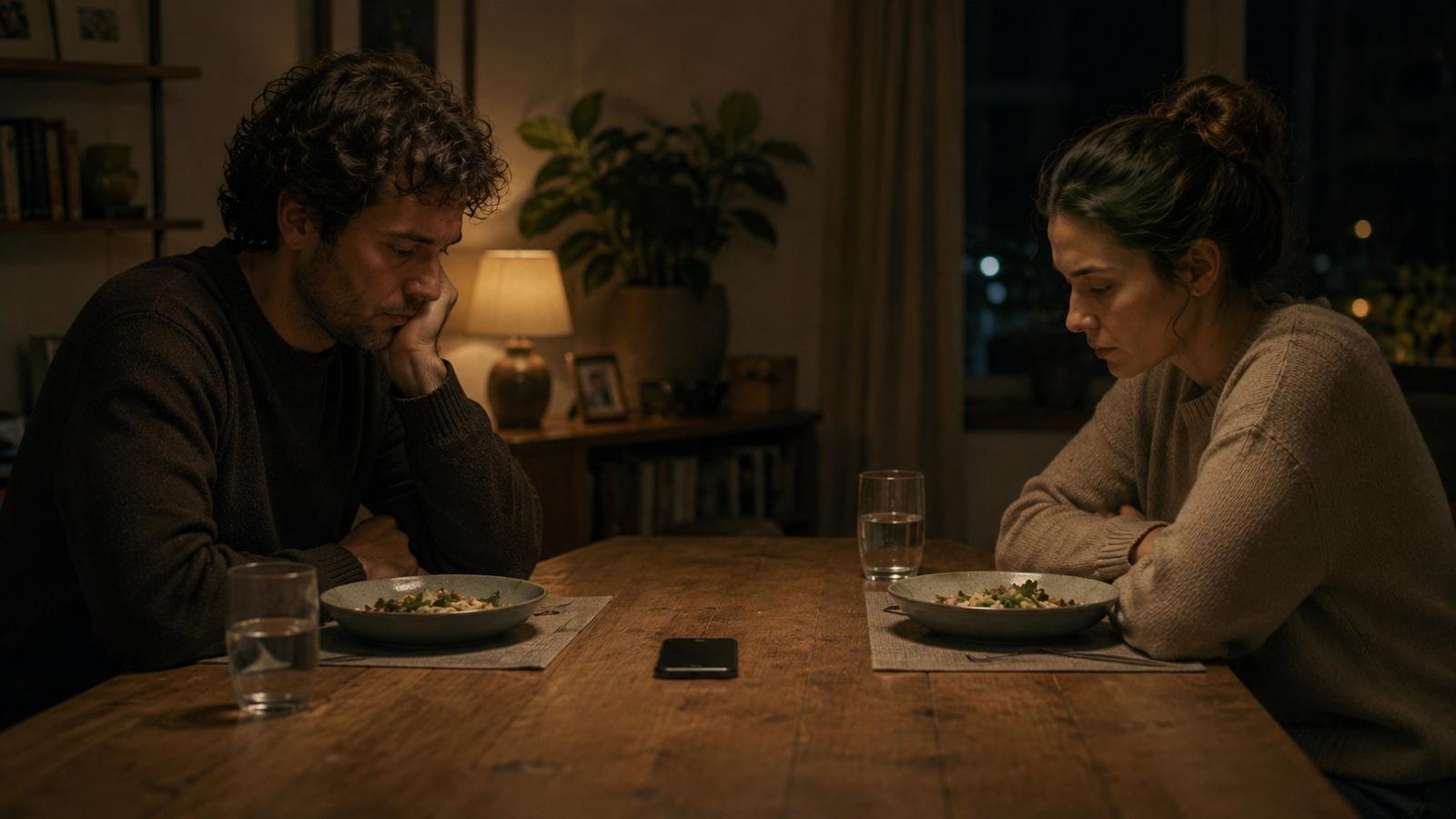
Phubbing is phone snubbing: looking at your phone instead of at the person in front of you. If you have ever sat across a table from someone whose eyes kept sliding downward, you know the feeling the word is pointing at.
There are now several hundred studies on it and at least two meta-analyses. There is also a good chance the word was invented to sell a dictionary.
Both of those things are worth knowing before you read anything else about it, because the second one explains a lot about the first.
The word came from an advertising agency
This is documented in the agency's own press release, so it is not a rumour.
In early 2012, McCann Australia devised a campaign for the Macquarie Dictionary. On 22 May 2012, a group of lexicographers, authors and poets was convened at the University of Sydney, recruited by Susan Butler, the dictionary's publisher and editor, and asked to coin a word for the behaviour. They produced "phubbing."
On 29 August 2012 the campaign launched at stopphubbing.com, presented as the work of a 23-year-old Australian named Alex Haigh. Haigh was an account executive at McCann. The agency's release describes it plainly: McCann was the "concept/asset developer," and its executive creative director noted that "to our knowledge, this is the first time the birth of a word has been captured on film."
The campaign worked. The word entered ordinary speech, then entered the research literature, and researchers began measuring it.
None of that makes the behaviour fake. People really do look at their phones instead of at each other, and that really does feel bad. But it is unusual for a scientific construct to arrive fully formed from a marketing brief, and it is worth holding in mind when you read that "studies show phubbing damages relationships."
What the meta-analyses found
The largest synthesis is Ni and colleagues (2025), which pooled 52 studies across 58 samples, N = 19,698, on partner phubbing specifically. Using Fisher's rz, the pooled associations were:
| Association | Pooled rz | 95% CI |
|---|---|---|
| Phubbing to relationship conflict | 0.573 | 0.228 to 0.918 |
| Media addiction to phubbing | 0.495 | 0.246 to 0.745 |
| Phubbing to partner responsiveness | -0.292 | -0.354 to -0.230 |
| Phubbing to jealousy | 0.289 | 0.166 to 0.412 |
| Attachment anxiety to phubbing | 0.240 | 0.149 to 0.325 |
| Phubbing to relationship satisfaction | -0.219 | -0.260 to -0.175 |
| Depression to phubbing | 0.185 | 0.137 to 0.234 |
A second meta-analysis, Arenz and Schnauber-Stockmann (2024), pooled 79 studies and 526 effect sizes on who phubs, and found the strongest predictors were problematic smartphone-use patterns rather than personality or demographics.
So the associations are real, consistent and reasonably large. The relationship-satisfaction one is about -0.22, which is a modest but genuine effect by the standards of relationship research.
Here is the problem. Almost every one of those studies is a cross-sectional survey in which one partner rates the other partner's phone use and also rates their own relationship satisfaction, at the same sitting, on the same questionnaire.
The study that complicates all of it
Carnelley and colleagues (2023) did something the rest of the literature mostly had not: they followed 100 couples for fourteen days with a dyadic daily diary, then came back two months later. Crucially, they measured phubbing two different ways: what each person actually did, and what their partner thought they did.
The two measures did not behave the same way.
Enacted phubbing, the partner's own report of how much they actually used their phone around the other person, did not predict relationship quality. The daily coefficients were B = -0.01 and B = -0.00, neither statistically significant. The fourteen-day average did not predict relationship quality two months later either.
Perceived phubbing, believing your partner was on their phone instead of with you, did predict lower relationship quality that day, B = -0.06, p = .021. But even that did not carry forward to the two-month follow-up.
Read those two results together and the standard story inverts. What tracks unhappiness is not how much your partner is on their phone. It is whether you experience them as absent. Those can come apart, and in this data they did.
That is not a small caveat. Nearly the entire phubbing literature measures the second thing while describing the first, because it asks unhappy people to rate their partner's behaviour. If dissatisfaction makes phone use more salient, and it plausibly does, then a large body of research may be documenting a consequence and calling it a cause.
Where there is genuine experimental evidence
One study did manipulate phubbing rather than measure it. Chotpitayasunondh and Douglas (2018) showed 128 participants a three-minute silent animation of two people in conversation and asked them to imagine being one of the figures. Three conditions: no phubbing (45), partial phubbing (45), extensive phubbing (38).
The effects were large.
| Outcome | No phubbing | Partial | Extensive | Statistic |
|---|---|---|---|---|
| Belonging | 4.01 | 2.62 | 1.82 | F(2, 125) = 80.75, p < .001, ηp² = .56 |
| Relationship satisfaction | 3.52 | 2.40 | 1.68 | F(2, 125) = 68.95, p < .001, ηp² = .53 |
| Meaningful existence | n/a | n/a | n/a | F(2, 125) = 57.13, p < .001, ηp² = .48 |
| Self-esteem | n/a | n/a | n/a | F(2, 125) = 41.17, p < .001, ηp² = .40 |
Belongingness mediated the effect on relationship satisfaction (β = .59, p < .001).
This is the strongest causal evidence in the field, and it establishes something narrow but solid: being visibly ignored in favour of a phone makes people feel less included, in the moment. It does not establish anything about what happens to a real relationship over years, because it was a three-minute cartoon.
The measurement instrument most of the literature uses, the nine-item Partner Phubbing scale, comes from Roberts and David (2016), developed across samples of 308 and 145 US adults. Their reported pattern, phubbing predicts phone-related conflict, which predicts lower relationship satisfaction, is the template the field has followed since.
What this does not show
It does not show that phones are damaging your relationship. The pooled effects are correlational. The one dyadic study that separated doing from perceiving found the doing did not predict anything.
It does not show a dose-response effect. Nobody has randomly assigned couples to more or less phone use over a meaningful period and measured what happened.
It is not a diagnosis, and nothing here is clinical advice. Phubbing is a behaviour described by a questionnaire, not a condition.
We have also not printed a sample size for Chotpitayasunondh and Douglas's earlier 2016 paper, or path coefficients for Roberts and David, because we could not retrieve the primary texts to verify them. Those figures circulate widely; we are not adding to the circulation.
The useful version
Strip out the parts that are not supported and something more practical is left.
The experimental evidence says that being visibly deprioritised for a screen produces an immediate, measurable drop in feeling included, and it is a large effect, not a subtle one. The dyadic evidence says that what predicts a bad day between two people is the perception of being deprioritised.
Those two findings agree with each other, and they point somewhere slightly different from "put your phone away." They point at whether the other person can tell they have your attention. A phone glanced at while someone is mid-sentence communicates something; the same glance during a lull does not. This is why the advice that actually follows from the research is about visible signalling rather than abstinence: saying what you are doing, or putting the phone somewhere the other person can see it is not being consulted.
And if you are the one who feels phubbed, the Carnelley result is worth sitting with rather than weaponising. The finding that perception drove the effect and enacted behaviour did not is not an accusation that you imagined it. It is a reason to say the thing out loud, because the gap between what someone is doing and what you are experiencing is exactly the kind of gap a sentence can close.
Phubbing sits alongside the other ways a device changes what happens between two people: see the screens, attention and focus guide for the wider picture, left on read for what a delivery receipt does to the same social nerve, and what notifications actually do for the interruption itself.


Human Operating System
Human Operating System is a research-led publication about the human mind under digital pressure. We report what the evidence does - and does not - support.
About Human Operating SystemSources & Further Reading
7 sourcesThese are the sources used for this article. Where a study's limits matter to the claim, those limits are kept in the citation.
View all 7 sourcesHide sources
- Ni, X., Ahrari, S., Zaremohzzabieh, Z., Zarean, F., & Roslan, S. (2025). A meta-analysis of partner phubbing and its antecedents and consequences. Frontiers in Psychology, 16, 1561159. Open source ↗
- Arenz, A., & Schnauber-Stockmann, A. (2024). Who "phubs"? A meta-analysis of predictors of phubbing. Mobile Media & Communication, 12(3), 637-661. Open source ↗
- Carnelley, K. B., Vowels, L. M., Stanton, S. C. E., Millings, A., & Hart, C. M. (2023). Perceived partner phubbing predicts lower relationship quality but partners' enacted phubbing does not. Computers in Human Behavior, 147, 107860. Open source ↗
- Chotpitayasunondh, V., & Douglas, K. M. (2018). The effects of "phubbing" on social interaction. Journal of Applied Social Psychology, 48(6), 304-316. Open source ↗
- Chotpitayasunondh, V., & Douglas, K. M. (2016). How "phubbing" becomes the norm: The antecedents and consequences of snubbing via smartphone. Computers in Human Behavior, 63, 9-18. Open source ↗
- Roberts, J. A., & David, M. E. (2016). My life has become a major distraction from my cell phone: Partner phubbing and relationship satisfaction among romantic partners. Computers in Human Behavior, 54, 134-141. Open source ↗
- McCann Worldgroup (2013). Introducing "Phubbing" [press release]. PR Newswire. Open source ↗
The Weekly System
Join the launch list for one calm, research-led email about attention, memory, learning and the systems designed to hold your attention. No noise, no panic and no unsupported certainty.