
Why you can study for hours and still remember nothing
You almost certainly don't have a memory problem. You have a method problem - and it's one almost nobody is taught to see.
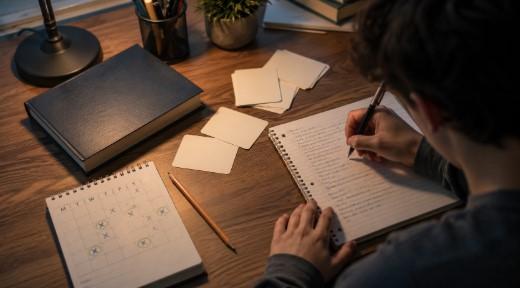
You read the chapter. You read it again. You highlighted the important parts - most of the page, in the end - and reread your notes until the words started to feel familiar. You closed the book genuinely believing you knew it.
Then the exam came, or just the next morning, and it was gone. Not fuzzy. Gone.
If that's you, you've probably decided you have a bad memory. That you're just not a "study person." That other people's brains hold onto this stuff and yours leaks.
Here's the more useful explanation: you almost certainly don't have a memory problem. You have a method problem - and it's one almost nobody is taught to see.
It's probably not your memory
Most of us were told to study and never told how memory actually works. So we default to the things that feel like studying: reading, rereading, highlighting, copying notes out neatly.
They feel productive. They take real hours. And they are, unfortunately, some of the weakest ways to make anything stick.
That's not a personal failing, and it isn't a sign that school failed you either. It's just that the methods that feel most effective and the methods that are most effective are two different lists - and almost everyone learns the first list by accident.
The trap: rereading builds familiarity, not memory
Here's the quiet catch. Every time you reread a page, it gets easier to read. The sentences flow, nothing surprises you, and your brain reads that ease as a signal: I know this.
You don't, necessarily. You've built familiarity - the page feels known - and mistaken it for recall - actually being able to produce the information when it's gone.
Researchers call this the fluency illusion, and it's one of the main reasons hours of studying can quietly evaporate. Robert and Elizabeth Bjork's work on "desirable difficulties" makes the uncomfortable point plainly: the feeling of ease while you study is a poor guide to whether you're learning.
It's worse than neutral, because familiarity is convincing. It's why you can finish a long session sure you're ready, and be blank a day later. You weren't lazy. You were fooled by your own fluency.
In the biggest review of study techniques we have - Dunlosky and colleagues' 2013 survey of the evidence - rereading and highlighting both landed in the "low utility" bracket. The techniques that topped the list were different in one important way: they make you do the hard part.
How memory actually gets built
Memory isn't built by putting information in front of your eyes again. It's built by pulling information out of your head. Four ideas do most of the work.
Retrieval. When you try to recall something from memory - and especially when it's a little effortful - you strengthen it far more than by rereading it.
In one well-known study, students who tested themselves remembered substantially more later than students who simply restudied the same material (Roediger & Karpicke, 2006). In another, retrieval practice even beat making elaborate concept maps (Karpicke & Blunt, 2011).
Retrieving isn't how you check that you've learned something. Retrieving is how you learn it.
Spacing. The same total study time works better spread across days than crammed into one sitting. A large review of the spacing effect found this again and again (Cepeda et al., 2006).
Three shorter sessions on three days generally beat one long night - partly because forgetting a little between sessions, then pulling it back, is exactly the effort that makes it stick.
Interleaving. Doing twenty of the same type of problem in a row feels smooth and productive. Mixing related types together feels messier and harder - and tends to produce better results later (Rohrer & Taylor, 2007; Kornell & Bjork, 2008).
The difficulty is the feature, not the bug.
Working-memory limits. There's also a simple ceiling. Your working memory can only hold so much at once (Sweller, 1988), so a marathon session where you try to pour in everything mostly overflows.
Shorter, focused, active sessions respect the limit instead of fighting it.
Notice the pattern across all four: the effective methods feel harder than rereading. That's not a coincidence. The effort is the thing doing the work.
Study differently tonight
You don't need a new brain or a new personality. You need to move the effort from your eyes to your memory.
Try this for a week and see what changes - for many people, this alone turns wasted hours into ones that actually hold.
Close the book and recall. Before you reread anything, write down everything you can remember from memory. The blanks are your real study list.
Turn your notes into questions. Instead of rereading a passage, rewrite it as questions you have to answer. "What are the three causes of X?" beats reading the paragraph about X for the fourth time.
Test yourself before you check. Answer from memory first, then look. The struggle before the answer is where the learning happens.
Space it across days. Break one long session into shorter ones spread over several days. Let yourself half-forget between them - that's the point.
Mix related topics carefully. Interleave a few related problem types rather than blocking one type at a time. Expect it to feel harder; that's the signal it's working.
Review your mistakes. The questions you got wrong are the most valuable thing on the page. Re-test those specifically until they're solid.
Stop relying only on rereading and highlighting. Use them as a first pass if you like - then switch to pulling the information back out.
None of this is exotic. It's just the difference between recognizing an answer and being able to produce one.
What this will - and won't - do
Be honest with yourself about what a method can do. Studying this way stacks the odds in your favor; it doesn't guarantee a grade, and it can't replace understanding the material in the first place or getting enough sleep before the exam.
How much it helps also depends on the subject and on you - some of this pays off faster for facts and problems than for essays.
It will probably feel worse before it feels better, too. Retrieval and spacing are less comfortable than rereading precisely because they're doing more.
That discomfort is a reasonable sign you're on the right track, not a reason to quit.
One thing you can safely take off your list: studying "to your learning style." There is little evidence that matching study methods to a "learning style" improves results (Pashler et al., 2008).
It's an appealing idea, and plenty of thoughtful people have believed it - but as a study strategy, your time is better spent on retrieval and spacing.
If you want to make this stick
Start free. We put the seven moves above into a one-page "How to Actually Study" checklist - a simple routine you can keep next to you while you work.
It's free; we'll email it to you with our weekly piece: one clear idea a week about the systems shaping modern life.
The free tool worth knowing
If you want to build spacing and self-testing into a habit without paying for anything, Anki is the tool most serious self-testers use.
It's free and open-source, it schedules your reviews for you, and it's built around exactly the retrieval-and-spacing idea this article is about. We're not paid to recommend it - it's just the honest starting point.
If you'd like to go deeper:
Recommended Resource:
What it is: Make It Stick: The Science of Successful Learning by Peter C. Brown, Henry L. Roediger III, and Mark A. McDaniel - the popular book written by the researchers behind much of the science in this article.
Why we'd recommend it: it sets out the same learning principles in more depth and with more worked examples than a single article can hold, and two of its three authors are the cognitive psychologists who ran much of the underlying research.
Who it's for: readers who want the full method, not just the summary.
What it won't do: it won't learn the material for you, and it's no substitute for the practice itself.
Note on independence: this is not an affiliate link and HOS earns nothing if you buy the book. We have not run a personal trial of it; the recommendation rests on its authorship and on its coverage of the principles above. See our affiliate disclosure for how paid links are handled elsewhere on the site.
Also in this series: the study tools and apps that are genuinely worth it - and the ones that just feel productive. You'll find more on learning and studying as the series grows. For the wider picture of what changes when a tool carries part of the thinking, see our guide to cognitive offloading.

Human Operating System
Human Operating System is a research-led publication about the human mind under digital pressure. We report what the evidence does - and does not - support.
About Human Operating SystemSources & Further Reading
14 sourcesThese are the sources used for this article. Where a study's limits matter to the claim, those limits are kept in the citation.
View all 14 sourcesHide sources
- Dunlosky, J., Rawson, K., Marsh, E., Nathan, M. & Willingham, D. (2013) - "Improving Students'
- Learning With Effective Learning Techniques" (Psychological Science in the Public Interest).
- Roediger, H. & Karpicke, J. (2006) - "Test-Enhanced Learning" (Psychological Science).
- Karpicke, J. & Blunt, J. (2011) - "Retrieval Practice Produces More Learning than Elaborative Studying
- with Concept Mapping" (Science).
- Cepeda, N., Pashler, H., Vul, E., Wixted, J. & Rohrer, D. (2006) - "Distributed Practice in Verbal
- Recall Tasks: A Review and Quantitative Synthesis" (Psychological Bulletin).
- Rohrer, D. & Taylor, K. (2007) - on interleaving practice (Instructional Science); Kornell, N. & Bjork,
- R. (2008), Psychological Science.
- Bjork, R. & Bjork, E. (2011) - "Making Things Hard on Yourself, but in a Good Way: Desirable
- Difficulties."
- Sweller, J. (1988) - "Cognitive Load During Problem Solving" (Cognitive Science).
- Pashler, H., McDaniel, M., Rohrer, D. & Bjork, R. (2008) - "Learning Styles: Concepts and Evidence"
- (Psychological Science in the Public Interest).
The Weekly System
Join the launch list for one calm, research-led email about attention, memory, learning and the systems designed to hold your attention. No noise, no panic and no unsupported certainty.