
Why Studying Next to Your Phone Wrecks Your Memory
Memory is built by attention, and the phone is very good at taking a cut of it. Switching between studying and a screen weakens learning, even when the session still feels productive.
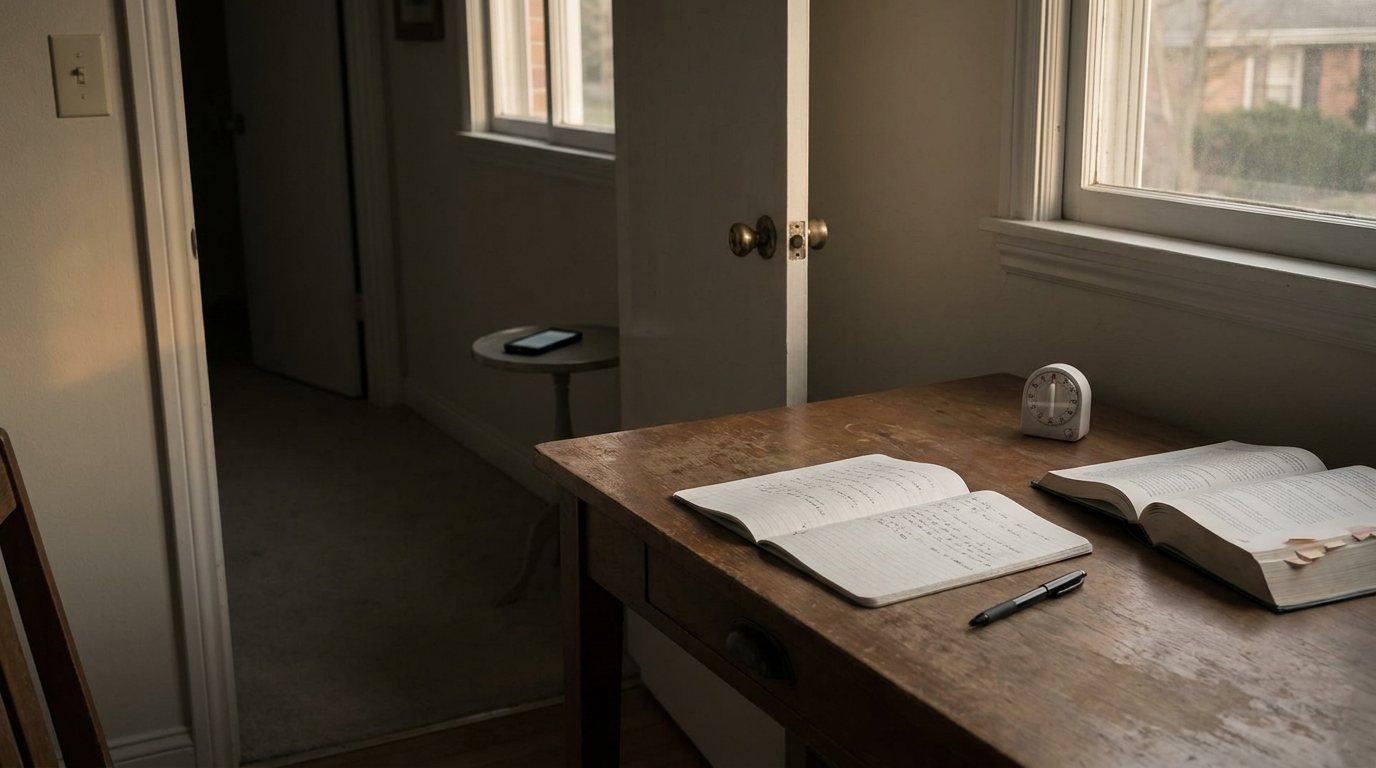
Two hours at the desk. Phone face-down beside you, untouched, just there in case.
You close the book and reach for what you read - and there's fog where the detail should be. You were present the whole time. So why didn't it stick?
Because memory is built by attention, and the phone is very good at taking a cut of it.
To hold onto something, you have to actually attend to it; divided attention produces a weaker copy. The clearest, most controllable drain on that attention while you study is the phone - and it's worth being precise about what the evidence does and doesn't show, because the honest version is more useful than the scary one.
What's well supported
Switching between studying and a screen hurts learning. Students who flick between work and a phone tend to learn less and remember less of the material (Rosen, Carrier & Cheever, 2013; Uncapher & Wagner, 2018), and each switch carries a hidden cost, because part of your attention stays snagged on the thing you just left (attention residue; Leroy, 2009).
Even a quick glance is more expensive than it feels.
What's not settled
Whether a phone that merely sits nearby, never touched, drains you. One well-known study reported exactly that (Ward et al., 2017) - but a pre-registered replication failed to reproduce it, and a later meta-analysis concluded the effect is small and unreliable (Ruiz Pardo & Minda, 2022; Böttger et al., 2023).
So treat "mere presence" as unproven, and act on the part that is solid. Conveniently, one move covers both.
First, though, the trap that keeps the habit alive: studying beside your phone still feels like studying. You spent the hours, you turned the pages - but feeling productive and building durable memory are different things, and the switching widens the gap without telling you.
So the fog gets blamed on a "bad memory," you study the same way again, and the loop holds. Leave it unchanged and it quietly teaches you the wrong lesson - that studying doesn't work for you - when what isn't working is studying beside a device engineered to hold your attention.
Over a term, that's the difference between hours that compound into recall and hours that evaporate.
The fix is one move
The fix is one move, and it's the primary one: put the phone in another room, not just face-down. Distance removes the well-supported problem (the glances) and any unproven one (mere presence) at the same time, so you don't have to know which mattered more.
Around it: work in real blocks of 25 to 45 minutes and let the phone be the break, not the companion; if it genuinely can't leave, switch on Focus or Downtime so it can't interrupt you mid-sentence; and study actively - close the book and recall, turn notes into questions, test yourself before checking - because passive rereading beside a phone is the weakest combination there is.
(The active-recall method is its own piece: why you can study for hours and remember nothing.)
You don't need to buy anything
You don't need to buy anything. The free version - phone in another room, a timer you already own - does the whole job, and it's the honest first step.
If you keep pulling the phone back "just for the timer," a lockable phone box can make the distance automatic; if you use one, set a short timer rather than a long lock, and keep it somewhere you could still reach the phone in a real emergency.
That's an optional convenience, not a requirement, and no product here is necessary.
Be honest about the ceiling
Be honest about the ceiling: this won't make a hard subject easy or guarantee a grade - understanding, sleep and study method all still matter, and effects vary.
And it isn't a diagnosis: struggling to focus with a phone nearby is a normal response to the device, not a sign something is wrong with you. If your focus problems are severe and reach well beyond studying, that's worth raising with a professional.
The next step
The next step that actually changes your grades is behavioural: put the phone in the next room for your next session. For the wider picture of what changes when a tool carries part of the thinking, see our guide to cognitive offloading.

Human Operating System
Human Operating System is a research-led publication about the human mind under digital pressure. We report what the evidence does - and does not - support.
About Human Operating SystemSources & Further Reading
13 sourcesThese are the sources used for this article. Where a study's limits matter to the claim, those limits are kept in the citation.
View all 13 sourcesHide sources
- Ward, A. F., Duke, K., Gneezy, A. & Bos, M. W. (2017). "Brain Drain: The mere presence of one's own smartphone
- reduces available cognitive capacity." Journal of the Association for Consumer Research, 2(2):140-154. DOI
- 10.1086-691462
- Ruiz Pardo, A. C. & Minda, J. P. (2022). "Reexamining the 'brain drain' effect: A replication of Ward et al. (2017)." Acta
- Psychologica, 230:103717. DOI 10.1016/j.actpsy.2022.103717. (Failed to replicate.)
- Uncapher, M. R. & Wagner, A. D. (2018). "Minds and brains of media multitaskers: Current findings and future
- directions." PNAS, 115(40):9889-9896. DOI Open source ↗
- Rosen, L. D., Carrier, L. M. & Cheever, N. A. (2013). "Facebook and texting made me do it: Media-induced
- task-switching while studying." Computers in Human Behavior, 29(3):948-958. DOI Open source ↗
- Sana, F., Weston, T. & Cepeda, N. J. (2013). "Laptop multitasking hinders classroom learning for both users and nearby
- peers." Computers & Education, 62:24-31. DOI Open source ↗
- Leroy, S. (2009). "Why is it so hard to do my work? The challenge of attention residue when switching between work
- tasks." Organizational Behavior and Human Decision Processes, 109(2):168-181. DOI Open source ↗
The Weekly System
Join the launch list for one calm, research-led email about attention, memory, learning and the systems designed to hold your attention. No noise, no panic and no unsupported certainty.