Do Blue Light Glasses Work? A Cochrane Review Says No - and the Screen Still Matters
A Cochrane review of 17 trials found blue-light glasses do not reduce eye strain or improve vision. Evening screen light still affects sleep - through brightness and timing.
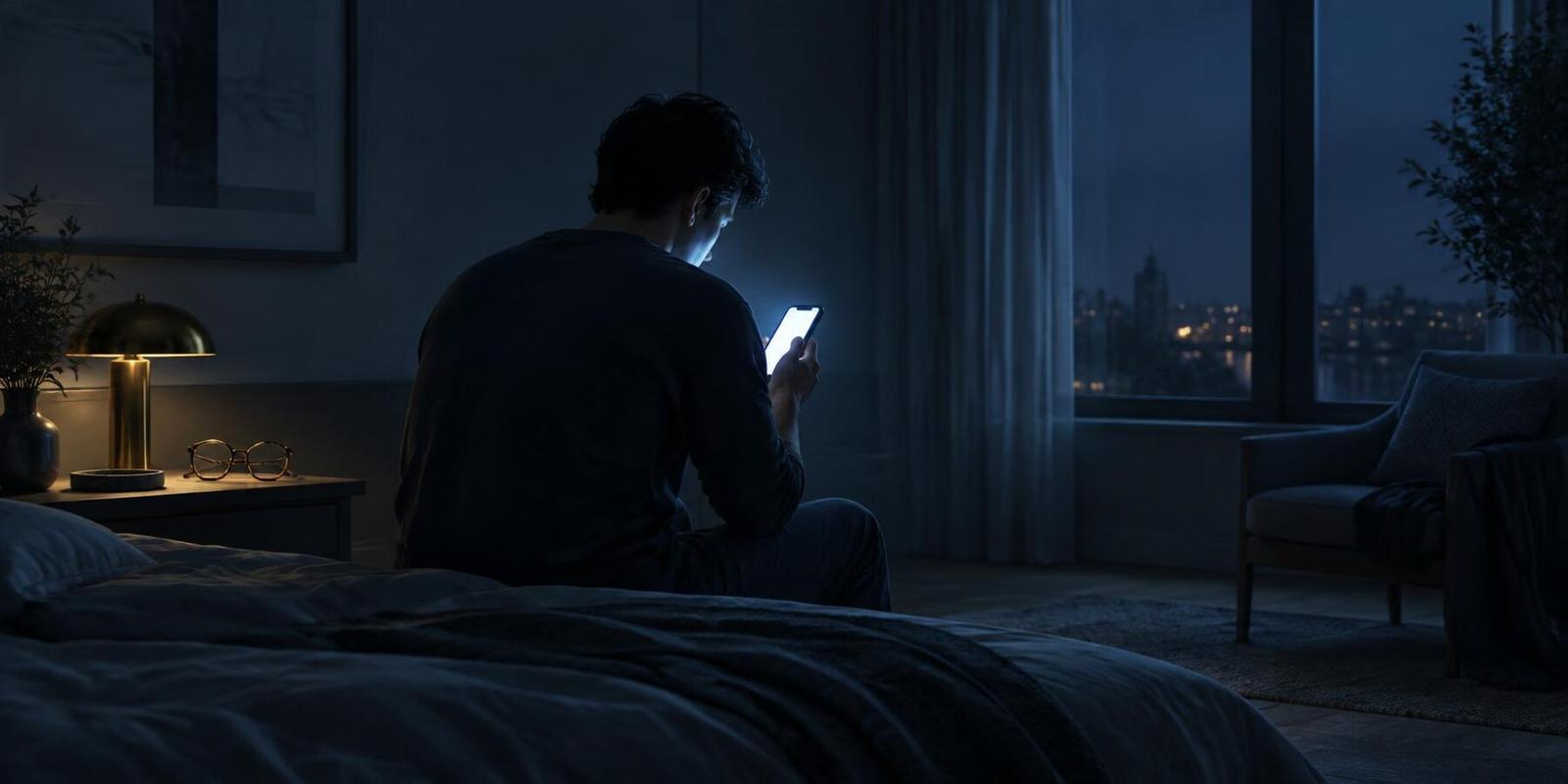
Two things are true at once here, and almost every article on this subject gets one of them wrong.
Evening light of sufficient intensity really does suppress melatonin and delay your body clock. That is measured, dose-dependent and causal.
Blue-light-filtering spectacle lenses do not fix it. They do not reduce eye strain, they do not improve visual performance, and the sleep evidence for them is graded very low certainty by the most rigorous synthesis available.
The gap between those two sentences is where a product category lives.
What the Cochrane review found
Singh and colleagues (2023) reviewed 17 randomised controlled trials with 619 participants across six countries for the Cochrane Database of Systematic Reviews. Follow-up ranged from under a day to five weeks.
| Outcome | Result | Certainty |
|---|---|---|
| Eye strain | MD 9.76 units worse with the filter (95% CI -33.95 to 53.47) | Low |
| Visual acuity | MD 0.00 logMAR (95% CI -0.02 to 0.02) | Moderate |
| Critical flicker-fusion frequency | MD -1.13 Hz (95% CI -3.00 to 0.74) | Low |
| Sleep quality | 6 trials, 148 participants - 3 improved, 3 null, not poolable | Very low |
| Macular health | No trial reported it at all | No evidence |
Read the eye-strain row carefully. The point estimate is in the wrong direction for the lenses, and the confidence interval is enormous - it runs from a large benefit to a large harm. That is not a finding that filters help; it is a finding that nobody has produced usable evidence either way, in the outcome the product is most often sold on.
The visual-acuity row is different, and stronger: a mean difference of exactly zero with a tight interval, graded moderate certainty. On vision, the answer is simply no.
And no included trial measured melatonin. The lenses have never been tested against the mechanism they are marketed on.
The trial that also rules out the placebo story
A reasonable objection is that if people believe the glasses work, they might feel better anyway. Singh, Downie and Anderson (2021) tested exactly this.
120 symptomatic computer users were randomised twice: once to receive positive or negative advice from the clinician about the lenses, then again to clear or blue-blocking lenses, before a two-hour computer task.
Neither manipulation did anything. Lens type: p = 0.304 on flicker fusion, p = 0.394 on symptoms. Clinician advocacy: p = 0.164 and p = 0.410.
So the glasses do not work, and being told enthusiastically that they work does not make them work either.
Where the earlier evidence sat
This is not a new finding that overturned an established one. Lawrenson, Hull and Downie (2017) had already reviewed the field and found only three randomised trials, around 136 participants between them - no visual-performance benefit, conflicting sleep results, and no studies at all on macular health. The 2023 review is the same conclusion with six times the trials behind it.
A 2025 meta-analysis of actigraphy-measured sleep outcomes (Luna-Rangel et al., three double-blind randomised crossover trials, 49 participants) found nothing on any measure, with zero heterogeneity: sleep onset latency -4.86 minutes (95% CI -20.23 to 10.52), total sleep time +8.75 minutes (95% CI -35.31 to 52.82), sleep efficiency -0.61% (95% CI -7.58 to 6.35).
The one synthesis that found a positive effect - and why it is not about your glasses
Shechter and colleagues (2020) pooled 12 studies and found benefits: sleep efficiency g = 0.31, total sleep time g = 0.32 (95% CI 0.01 to 0.63), and a large effect on the Pittsburgh Sleep Quality Index (g = -1.25).
This is the study that gets cited by manufacturers, and it is real. But look at what it pooled: amber and orange therapeutic lenses, worn in the hours before bed, largely by clinical populations - people with insomnia, bipolar disorder, delayed sleep phase, ADHD. Study samples ran from six to twenty-one people.
That is a chronotherapeutic device used at a specific time for a specific condition. It is not the faintly yellow-tinted computer glasses sold to office workers, which is what the Cochrane review evaluated and found inert. Do not let the two collapse into one claim - including when a retailer does it for you.
The part that is real
Screen light at sufficient intensity does affect your body clock, and here the evidence is good.
Schöllhorn and colleagues (2023) studied 72 healthy men in a within-subject design, manipulating display light at four luminance levels crossed with low and high melanopic content for four hours before habitual bedtime. Melatonin was significantly higher under the low-melanopic condition at all four intensities (all p < 0.01) - roughly a 50% difference in melatonin AUC between the extremes. Melatonin onset came about half an hour earlier, and sleep latency was around 50% longer at the high-melanopic extreme, F(1,17) = 6.13, p = 0.024.
The key insight is what the dose actually is: melanopic irradiance, not “blue light” as a colour. And it is dose-dependent, which means intensity and duration matter more than spectrum.
Chang and colleagues (2015) had shown the same direction in an inpatient study comparing light-emitting e-readers against print books - longer sleep onset, suppressed melatonin, delayed circadian phase, worse next-morning alertness. We are not printing that study’s figures because we could not retrieve its full text to verify them. Its design caveat is worth stating anyway: four hours of reading at maximum brightness in a light-controlled laboratory is a large dose, and there is a published exchange in the same journal disputing how well it generalises.
Software filters do not rescue it either
If the lenses fail, the obvious next question is whether the phone’s own night mode works.
Duraccio and colleagues (2021) tested 167 participants across three conditions for seven nights each with actigraphy: phone with Night Shift on, phone with Night Shift off, and no phone. Every comparison was null - sleep onset latency p = .85, sleep efficiency p = .86, total sleep time p = .59, wake after sleep onset p = .81.
Among the better sleepers, no phone beat Night Shift on efficiency (p = .018) and wake after sleep onset (p = .021), while Night Shift conferred no advantage over an unfiltered phone.
What this does not settle
It is not a clean null of a good literature. Independent commentators reviewing the Cochrane result noted that roughly two-thirds of the underlying trials were unregistered and fewer than half reported basic statistics. The certainty ratings - low, low, very low - say this plainly. The honest summary is that the lenses have not been shown to work, not that they have been shown to do nothing.
Nothing here is medical advice, and nothing here is about eye disease. No trial in the review measured macular health at all, so the protective claims sometimes made for these lenses have no evidence behind them in either direction.
Adverse events were reported across nine trials and 333 participants - headache, discomfort, in one study lowered mood - but at rates comparable to the control lenses.
What to do instead
The evidence points somewhere unglamorous.
The dose is intensity and timing, not colour. Schöllhorn’s melatonin effect tracked melanopic irradiance across luminance levels. Dimming the screen and moving the exposure earlier acts on the actual variable. A filter that changes the tint while you keep the brightness up at midnight does not.
In the better-sleeper data, not having the phone beat filtering the phone. That is the only comparison in this literature that produced a benefit, and it involved no product.
If eye strain is your problem, the lenses are the wrong intervention. The trials that measured it found nothing, and the one that manipulated clinician enthusiasm found that did nothing either. Screen distance, breaks and a proper eye test are outside this evidence base but inside the actual causes.
Blue light glasses are an unusually clean example of a broader pattern: a real mechanism, a plausible-sounding device, and no measured connection between them.
Screen light is one of several things people try to solve with a purchase - see the screens, attention and focus guide for the wider picture, why you can’t stop scrolling in bed at night for what is actually keeping you up, and grayscale phone for another display change tested honestly.

Human Operating System
Human Operating System is a research-led publication about the human mind under digital pressure. We report what the evidence does - and does not - support.
About Human Operating SystemSources & Further Reading
8 sourcesThese are the sources used for this article. Where a study's limits matter to the claim, those limits are kept in the citation.
View all 8 sourcesHide sources
- Singh, S., Keller, P. R., Busija, L., McMillan, P., Makrai, E., Lawrenson, J. G., Hull, C. C., & Downie, L. E. (2023). Blue-light filtering spectacle lenses for visual performance, sleep, and macular health in adults. Cochrane Database of Systematic Reviews, 8, CD013244. Open source ↗
- Singh, S., Downie, L. E., & Anderson, A. J. (2021). Do blue-blocking lenses reduce eye strain from extended screen time? A double-masked randomized controlled trial. American Journal of Ophthalmology, 226, 243-251. Open source ↗
- Lawrenson, J. G., Hull, C. C., & Downie, L. E. (2017). The effect of blue-light blocking spectacle lenses on visual performance, macular health and the sleep-wake cycle: A systematic review. Ophthalmic & Physiological Optics, 37(6), 644-654. Open source ↗
- Luna-Rangel, F. A., et al. (2025). Efficacy of blue-light blocking glasses on actigraphic sleep outcomes: A systematic review and meta-analysis. Frontiers in Neurology, 16, 1699303. Open source ↗
- Shechter, A., Quispe, K. A., Mizhquiri Barbecho, J. S., Slater, C., & Falzon, L. (2020). Interventions to reduce short-wavelength (“blue”) light exposure at night and their effects on sleep: A systematic review and meta-analysis. SLEEP Advances, 1(1), zpaa002. Open source ↗
- Schöllhorn, I., Stefani, O., Lucas, R. J., Spitschan, M., Slawik, H. C., & Cajochen, C. (2023). Melanopic irradiance defines the impact of evening display light on sleep latency, melatonin and alertness. Communications Biology, 6, 228. Open source ↗
- Duraccio, K. M., Zaugg, K. K., Blackburn, R. C., & Jensen, C. D. (2021). Does iPhone night shift mitigate negative effects of smartphone use on sleep outcomes in emerging adults? Sleep Health, 7(4), 478-484. Open source ↗
- Chang, A.-M., Aeschbach, D., Duffy, J. F., & Czeisler, C. A. (2015). Evening use of light-emitting eReaders negatively affects sleep, circadian timing, and next-morning alertness. PNAS, 112(4), 1232-1237. Open source ↗
The Weekly System
Join the launch list for one calm, research-led email about attention, memory, learning and the systems designed to hold your attention. No noise, no panic and no unsupported certainty.