
Why you and your partner are always on your phones
A small, well-documented pattern in modern relationships, with no villain and one small shared change.
You and the person you love are together at dinner, both half on your phones, and a small distance has opened up neither of you meant. The behaviour has a name - phubbing - and the research is real but narrower than the scare stories. Here is what is actually happening, with no villain, and one small shared change worth trying.
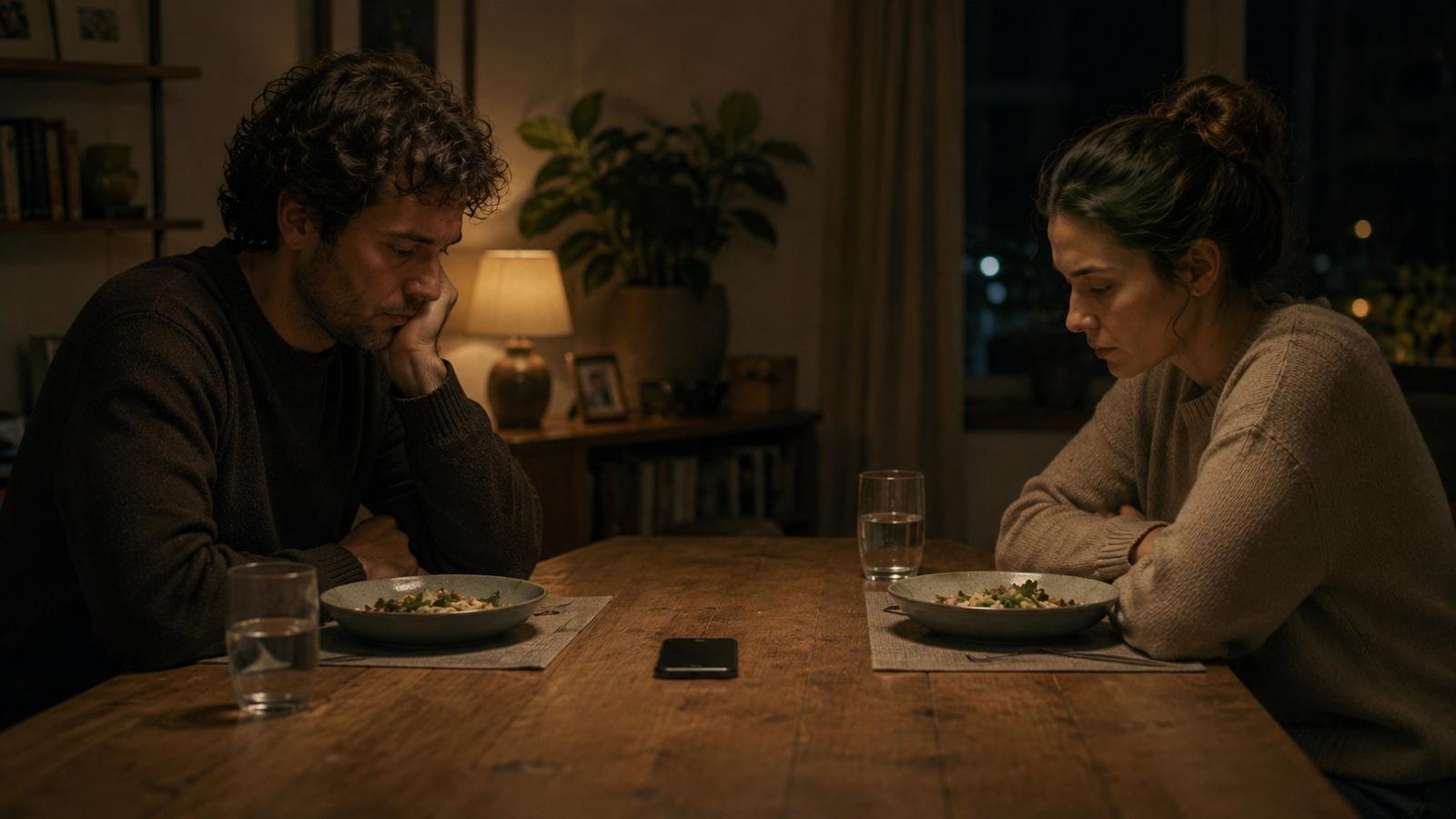
You are at dinner with the person you love. Nothing is wrong. But you are both half on your phones - a glance here, a reply there, a scroll during a lull - and somewhere in the middle of it a small quiet distance has opened up that neither of you decided to create. You are together, and you are also not quite with each other, and you both feel it a little, even if nobody says so.
There is a name for this. Researchers call it phubbing - a mash-up of phone and snubbing - and when it happens between partners they call it partner phubbing. None of it means your relationship is failing, and neither of you is at fault. It is a small, specific, well-documented pattern in romantic relationships, and it is worth understanding precisely, because the remedy is small too.
What phubbing behaviour actually is
Phubbing means glancing at your phone during a moment you are supposedly sharing with someone else. On its own, any single instance is nothing - a quick check, a reply that could not wait. The pattern is not built from any one glance. It is built from the accumulation.
Here is why it carries more weight than it seems to. A face-to-face conversation is a series of small moments where one person is, in effect, asking for the other''s attention. When you turn to your phone in one of those moments, you send a tiny, wordless signal about priority - not "I hate you," nothing so dramatic, just "this, right now, has edged ahead of you." One of those signals is meaningless. Hundreds of them, over months, quietly teach a person where they rank. That is the mechanism. Not a phone destroying love, but a small repeated signal about who has your attention, compounding.
It is worth saying that phubbing is not only a couples problem. The same behaviour shows up between friends, between colleagues, and between parents and children - researchers have a separate line of work on parental phubbing for exactly that reason. The dinner table is simply where most people notice it first.
Is phubbing rude, or just normal now?
Both, which is why it is awkward to talk about. The gesture reads as rude in the moment - the other person can see the attention leave - while the habit itself has become so ordinary that calling it rude sounds prim. That gap is the whole difficulty. It is why most couples never raise it: the behaviour feels too small to be worth a conversation, and the accumulated effect feels too large to name without it sounding like an accusation.
The useful reframe is to stop asking whether it is rude and start asking what it signals. Rudeness is about manners. This is about priority, repeated often enough to be learned.
What the research on partner phubbing actually shows
This is a subject where it is easy to overclaim, so here is the careful version.
Studies of couples do find a real, consistent link. In the work that named partner phubbing, people who felt phubbed by their partner reported more conflict over phone use and, through that conflict, lower relationship satisfaction - an effect that was stronger for people higher in attachment anxiety. A parallel line of research on technoference - everyday technology intruding on couple time - found the same shape: more interruptions, more conflict, lower satisfaction. And a 2025 meta-analysis pooling 52 studies and close to twenty thousand people found that partner phubbing was reliably associated with lower relationship satisfaction, at a pooled correlation of roughly -0.22 - small-to-moderate by the usual benchmarks, and clearly not nothing.
Does phubbing actually harm relationships?
Now the honesty, because it matters and it protects you from panic. All of this is correlational. It shows that phubbing and dissatisfaction travel together; it does not prove that the phone causes the unhappiness rather than, say, unhappy partners retreating into their phones - almost certainly it runs both ways. The same meta-analysis found that the link to overall life satisfaction did not reach statistical significance, and was estimated too imprecisely to say much either way, so this is about the relationship specifically, not a claim that your phone is making your whole life worse. And one famous idea - that merely having a phone visible on the table lowers the quality of a conversation - did not survive a careful close replication, so the evidence points at active use, the actual glancing away, rather than the phone simply sitting there.
The reliable finding is narrower and truer than the scary headline: repeatedly turning your attention to the phone during shared moments is associated with a modestly worse relationship. That is enough to act on. It is not a reason to catastrophise, and it is certainly not evidence that phones end marriages.
Nobody here is the villain
It is important to say this plainly, because articles like this usually pick a culprit. There isn''t one. Neither you nor your partner is a bad person for reaching for the phone at the table. Reaching for the phone is close to a universal reflex now, and everything around it keeps that reflex topped up - HOS has written separately about how much of the pull sits in the settings a phone arrives with rather than in anyone''s weak character. The habit is ordinary. You both have it.
Framing it as "my partner is addicted and ignoring me" turns a shared, ordinary pattern into an accusation, and accusations make people defensive, which makes them retreat further - often into the phone. The moment this becomes one person''s fault, you have made it harder to fix.
The accurate frame is that the two of you have drifted into a shared habit that is quietly costing you something, and you can step out of it together, on the same side.
The cost of leaving it alone
Left alone, the pattern has a particular way of compounding. The small distance at dinner makes conversation a little less rewarding, which makes the phone a little more tempting, which opens the distance a little further.
Nobody chooses it, and no single evening matters, but a year of slightly-less-present dinners adds up to a couple who are technically together and quietly less close than they were - not through any crisis, just through a thousand small glances away.
It is the same quiet arithmetic that can leave someone feeling alone in a room full of people, or a whole household eating dinner on separate screens. That is the real cost: not a dramatic rupture, but a slow thinning of the emotional closeness you would most want to protect.
How to stop phubbing without a digital detox
Because the pattern is small and mutual, the response can be too. It does not call for a detox or a dramatic renunciation, and it is worth being clear about what follows: none of it has been tested as a relationship intervention. The research describes an association, not a treatment. What it supports is a reasonable shared response to something you have both noticed - one agreement, and a little grace.
Name it together, gently, as a pattern you have both fallen into rather than a fault in either of you. Then agree one phone-free zone or time you both keep - the dinner table, the first hour after you are both home, the evening walk. Not the whole day. One protected pocket where the phones are face-down and out of hand, so the signal you are sending each other in that pocket is "you have my attention," reliably.
Put the phone out of reach, not just on silent. The evidence points at active use rather than mere presence, but a phone in your hand is a phone you will glance at.
And when one of you slips, because you both will, repair it lightly - "sorry, you were saying" - rather than keeping score. The point is not perfect discipline. The point is to keep a little clearing where you are actually with each other.
The short version
Phubbing is glancing at your phone during a shared moment. Done often enough, it is associated with a modestly less satisfying relationship - an association, not a proven cause, and not a verdict on your life as a whole. Nobody in your house is the villain. And the response that makes sense is not a detox but one protected pocket of the day, agreed together, phones down - a small, low-cost experiment rather than a proven remedy.
You did not mean to let a small distance open up between you. Almost no couple does. If it closes at all it will close the way it opened: quietly, and on both sides. One protected pocket of the day, phones down and attention actually on each other, is a reasonable place to start - small enough to be worth trying before anything larger, and pointed at the thing the person across from you was quietly asking for all along. Not the whole evening. Some of it.

Human Operating System
Human Operating System is a research-led publication about the human mind under digital pressure. We report what the evidence does - and does not - support.
About Human Operating SystemSources & Further Reading
4 sourcesThese are the sources used for this article. Where a study's limits matter to the claim, those limits are kept in the citation.
- Roberts, J. A. & David, M. E. (2016). My life has become a major distraction from my cell phone: Partner phubbing and relationship satisfaction among romantic partners. Computers in Human Behavior, 54, 134-141. Open source ↗
- McDaniel, B. T. & Coyne, S. M. (2016). "Technoference": The interference of technology in couple relationships and implications for women's personal and relational well-being. Psychology of Popular Media Culture, 5(1), 85-98.
- Ni, N., Ahrari, S., Zaremohzzabieh, Z., Zarean, M. & Roslan, S. (2025). A meta-analytic study of partner phubbing and its antecedents and consequences. Frontiers in Psychology, 16, 1561159. Open source ↗
- Przybylski, A. K. & Weinstein, N. (2013). Can you connect with me now? Journal of Social and Personal Relationships, 30(3), 237-246 - note: the "mere presence" effect failed to replicate in Linares, C. & Sellier, A. (2021), PLOS ONE, 16(6), e0251451. Open source ↗
The Weekly System
Join the launch list for one calm, research-led email about attention, memory, learning and the systems designed to hold your attention. No noise, no panic and no unsupported certainty.