Why you sit down to work and lose 40 minutes without noticing
You didn't lose the time because you're undisciplined or don't care. You lost it because you switched - from the task to the tab, from the tab to the next tab, from there to a thought, and eventually back.
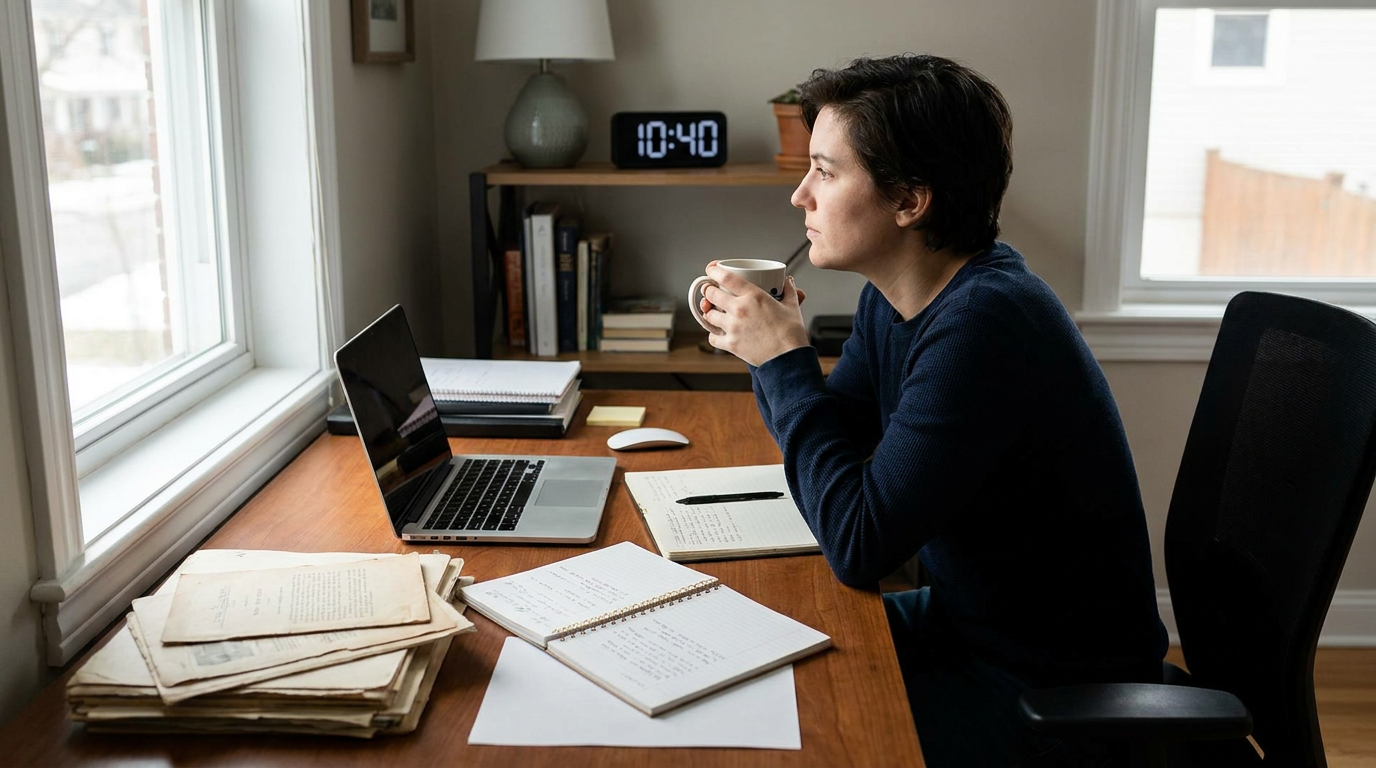
You sat down to work. You had one clear task and every intention of doing it. You opened the laptop - and then, before you typed a single word, you "just quickly" checked one thing. A message. An email. The fact you needed to look up.
When you surface again, forty minutes are gone. The task is still sitting there, untouched. And the strangest part is that you can't quite account for the time. You weren't slacking off, exactly. You were busy. You just have nothing to show for it.
If that's a familiar feeling, here's the more useful way to see it: you didn't waste those forty minutes. They were taken from you - in the small, invisible gaps between one thing and the next.
It's not that you're lazy. You switched.
Let's put the self-blame down first, because it's aimed in the wrong direction.
You didn't lose the time because you're undisciplined or don't care. You lost it because you switched - from the task to the tab, from the tab to the next tab, from there to a thought, and eventually back. Each of those switches felt like nothing. Together, they ate the block.
That matters, because the fix for "I'm lazy" is shame, and shame doesn't work. The fix for "I keep switching" is a different setup. One of those is a dead end. The other is something you can actually change.
Starting has a cost - and every interruption charges it again
Here's the hidden system underneath the lost time.
Getting into a task isn't free. There's a small cost every time your brain moves from one activity to another - researchers call it the cost of task switching, and it's one of the most reliably observed findings in the study of attention and focus (Rubinstein, Meyer & Evans, 2001; Monsell, 2003). Switching feels instant, but it isn't. Each move charges a little tax in time and mental effort.
And the tax gets charged again every time you come back. When you leave a task and return, you don't pick up exactly where you left off - you have to rebuild it: where was I, what was I about to do, what did that sentence mean? Psychologists describe this as the effort of reactivating a goal you'd set down (Altmann & Trafton, 2002).
It's why the first minutes after any interruption feel like climbing back up a slope you'd already climbed. Interrupted work can still get finished, but research links it with more stress, effort, and frustration (Mark, Gudith & Klocke, 2008) - you pay for the switch twice, once in time and once in wear.
Then there's the part that makes "quick checks" so expensive. When you switch away from something, a piece of your attention stays behind on it. Sophie Leroy named this attention residue: after you glance at the other thing, you're not fully on the new thing - part of you is still back there, and your performance dips because of it (Leroy, 2009).
You close the message, but for the next few minutes half of you is still drafting the reply. The unanswered ones are the worst, because unfinished things tug hardest - a message you haven't dealt with stays half-open in your mind and keeps pulling at you until you do.
So the real cost of "I'll just check this" isn't the thirty seconds of checking. It's the residue it leaves, and the climb back up afterward.
Two more things quietly widen the leak. The first is that real work is far more fragmented than it feels from the inside. When researchers actually watch how people work, they find the day chopped into surprisingly short segments, with switches happening far more often than anyone would guess (González & Mark, 2004). Most of those switches aren't dramatic interruptions - they're the small, self-started ones you don't even register.
The second is that not all of it is the phone's fault. Even in a silent room with everything closed, minds wander - a large share of the time, according to research that sampled people throughout their ordinary days (Killingsworth & Gilbert, 2010). Some of your lost forty minutes is simply your own attention drifting, and it helps to know that so you don't blame the notifications for all of it.
Put it together and the picture is calm rather than damning: you sat down, made a few switches that each cost more than they looked like, left residue on the task every time, and drifted a little on your own. No character flaw required. Just a system that leaks unless you protect it.
Protect the first forty minutes
You don't need a new personality or more willpower. You need to protect the opening block - the exact place the time usually leaks - by removing the triggers and deciding the work in advance. Try this as a one-week experiment and notice what changes. For many people, guarding just the first block is the difference between a lost morning and a finished task.
Decide the one task before you sit down. Not "work on the report" - name it in a sentence: "draft the opening section." Deciding exactly what you'll do the moment you sit, before you sit, is one of the most reliable ways to actually follow through (Gollwitzer, 1999).
Open only what that task needs. One document, one tab. Every extra open tab is a standing invitation to switch - close them and the invitations disappear.
Put the phone out of reach, or turn on Focus. Distance beats discipline; across the room beats face-down. If it stays near, turn on your phone's built-in Focus or Do Not Disturb mode to silence the pings. More on that in Your phone isn't the problem. Its defaults are.
Close the inbox and messages. These are the highest-frequency switch triggers you own. They can wait one block. Nothing in there needs you in the next half hour.
Set one timed block of 25 to 40 minutes. A defined start and a defined end. The timer turns an open-ended slog into a container you can actually see the edge of - the idea behind the Pomodoro technique, and you don't need an app to do it.
Use one re-entry rule when you drift. When you catch yourself somewhere else, don't audit it and don't scold yourself - just return to the one task. A single calm rule beats a rule for every temptation.
Write the next step before you take a break. One line - "next: add the second example" - so the task closes cleanly instead of tugging at you the whole break, and so your next session starts instantly instead of cold.
Notice the pattern: you're not out-muscling the distractions. You're changing the setup so there are fewer switches to make in the first place.
What this will - and won't - do
Be honest with yourself about the size of this. Protecting the first block reduces the triggers and gives your attention a clean runway. It does not magically manufacture focus, and it won't fix the things underneath a bad work session - exhaustion, stress, poor sleep, or a workload that was never realistic to begin with. No routine solves those, and it's not a personal failure that this one doesn't.
How much it helps also varies by person and by task. Some days it turns a wasted morning around completely; some days it buys you back ten honest minutes and that's all. Both are wins. This isn't a cure or a character test - it's removing a few thumbs that were quietly pressing on the scale, so that when you do sit down to work, you're not also fighting a setup designed to pull you away.
If you want to make this stick
Start free, right now. We put the seven steps above onto a single page - the "First 40 Minutes" checklist - so you can run the routine without remembering it. It's free; we'll email it to you along with our weekly piece: one clear idea a week about the systems shaping modern life.
The free method worth trying first. You can do the whole thing tonight without spending anything: phone across the room, your device's built-in Focus mode on, and a plain timer set for one block. That combination handles most of the leak on its own - no purchase required.
If you want to make the block harder to break - especially across a laptop and a phone, where willpower tends to lose:
Recommended Resource
What it is: Freedom - a website and app blocker that shuts off your most tempting sites and apps for a set period, in sync across your computer and phone.
Why we'd recommend it: it turns "don't check the tab" from a decision you have to keep making into a setting that holds it for you, on every device at once.
Who it's for: readers who've tried the free routine and want the trigger removed automatically rather than by willpower.
What it won't do: it won't create focus for you, and it's no substitute for deciding what you'll actually work on.
Note on independence and evidence: this is not an affiliate link and HOS earns nothing if you sign up. A documented retrieval did not locate an independent peer-reviewed trial of Freedom's effectiveness, so treat it as a tool built on a supported mechanism rather than a product shown to work. See our affiliate disclosure for how paid links are handled elsewhere on the site.
Also worth trying: if the pattern above sounds like yours, an auto-scheduling tool such as Motion Daily Planner takes the 'what do I work on next' decision off your plate hour by hour.
Also in this series: a hands-on comparison of the focus and blocking tools that genuinely earn their place - and the ones that just feel productive without doing much. If you want the whole map first, our guide to digital distraction and focus sets out which claims about attention hold up and which do not.

Human Operating System
Human Operating System is a research-led publication about the human mind under digital pressure. We report what the evidence does - and does not - support.
About Human Operating SystemSources & Further Reading
11 sourcesThese are the sources used for this article. Where a study's limits matter to the claim, those limits are kept in the citation.
View all 11 sourcesHide sources
- Sources & Further Reading
- Rubinstein, J., Meyer, D. & Evans, J. (2001) - "Executive Control of Cognitive Processes in Task Switching" (Journal of Experimental Psychology: Human Perception and Performance).
- Monsell, S. (2003) - "Task Switching" (Trends in Cognitive Sciences).
- Leroy, S. (2009) - "Why Is It So Hard to Do My Work? The Challenge of Attention Residue When Switching Between Work Tasks" (Organizational Behavior and Human Decision Processes).
- Mark, G., Gudith, D. & Klocke, U. (2008) - "The Cost of Interrupted Work: More Speed and Stress" (CHI '08).
- González, V. & Mark, G. (2004) - "'Constant, Constant, Multi-tasking Craziness': Managing Multiple Working Spheres" (CHI '04).
- Killingsworth, M. & Gilbert, D. (2010) - "A Wandering Mind Is an Unhappy Mind" (Science).
- Altmann, E. & Trafton, J. (2002) - "Memory for Goals: An Activation-Based Model" (Cognitive Science).
- Gollwitzer, P. (1999) - "Implementation Intentions: Strong Effects of Simple Plans" (American Psychologist).
- Newport, C. (2016) - Deep Work: Rules for Focused Success in a Distracted World.
- None of the links in this section are affiliate links. How we choose and check our sources: research standards (/research-standards).
The Weekly System
Join the launch list for one calm, research-led email about attention, memory, learning and the systems designed to hold your attention. No noise, no panic and no unsupported certainty.