Is Dark Mode Better for Your Eyes? No Controlled Study Has Found That It Is
The one crossover trial found no difference in eye strain. Light mode reads better in dim light, the sleep claim tests the wrong variable, and the battery saving depends on brightness.
Eye strain, sleep and battery life: what controlled studies actually measured about dark and light display modes, and the one place where dark mode genuinely wins.
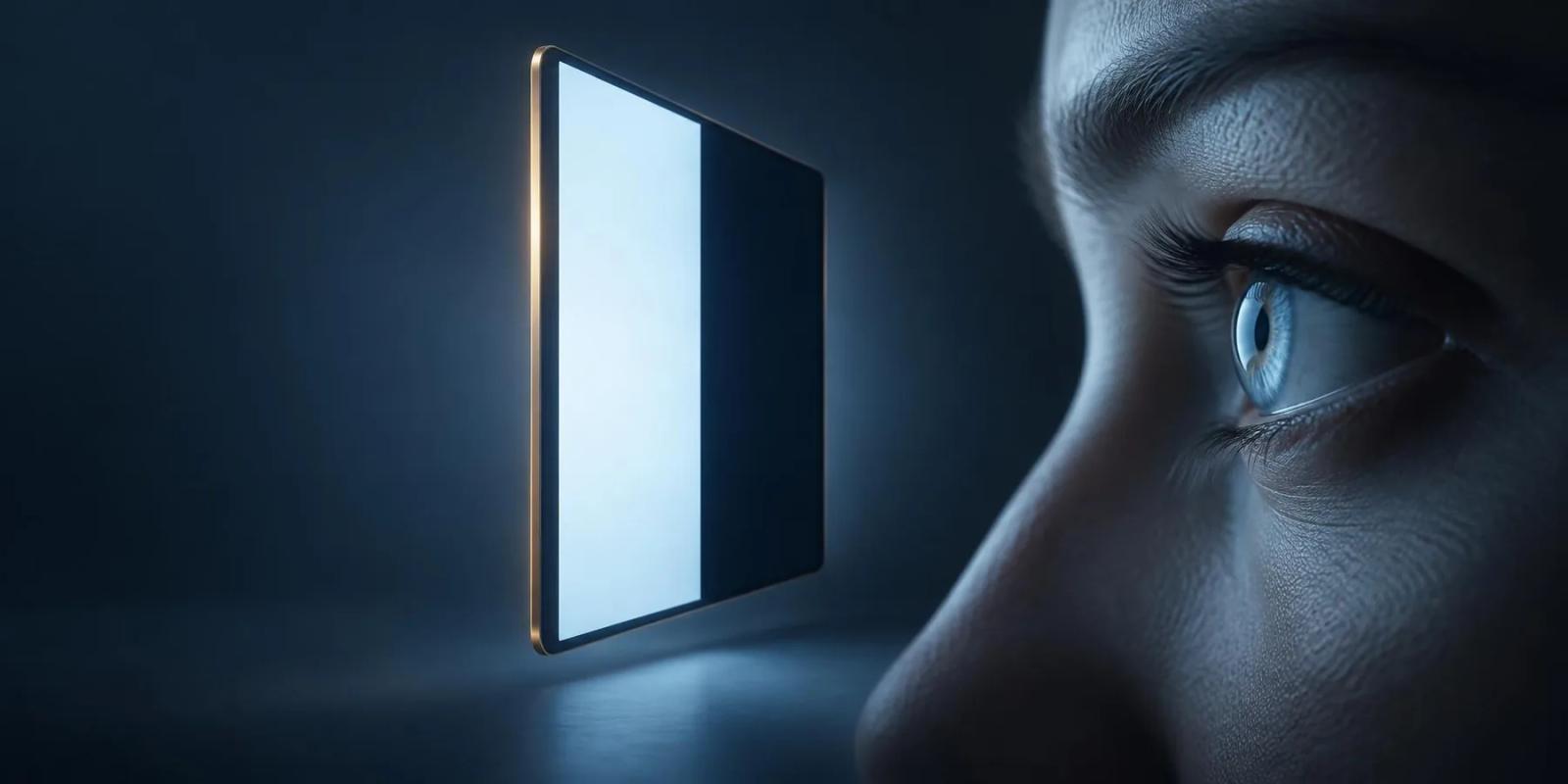
Three claims are made for dark mode: it is easier on your eyes, it helps you sleep, and it saves your battery.
The first has no controlled evidence behind it, and the one crossover trial that tested it found no difference. The second tests the wrong variable. The third is true only at a brightness almost nobody uses.
What the research does show is the opposite of the folk belief, with a genuinely interesting exception at the end.
The measured finding runs the other way
The technical terms are positive polarity - dark text on a light background, what you would call light mode - and negative polarity, light text on dark.
Piepenbrock, Mayr, Mund and Buchner (2013), in Ergonomics, tested 169 people (85 older, mean age 69.8; 84 younger, mean age 22.6) in a two-by-two between-subjects design.
Visual acuity: polarity F(1,163) = 69.31, p < .01, η2 = 0.30. Younger adults t(82) = 9.93, p < .01, d = 2.17. Older adults t(81) = 2.53, p = .01, d = 0.58.
Proofreading: polarity F(1,165) = 9.92, p < .01, η2 = 0.06, with no interaction by age.
Positive polarity - light mode - won on both, for both age groups.
Piepenbrock, Mayr and Buchner (2014), in the same journal, found the mechanism with 35 participants in a within-subjects design:
| Measure | Effect |
|---|---|
| Pupil diameter | 2.09 mm (light) vs 3.65 mm (dark), t(34) = -17.49, p < .01, dz = 2.96 |
| Proofreading accuracy | t(34) = 4.54, p < .01, dz = 0.77 |
| Reading rate | t(34) = 4.04, p < .01, dz = 0.68 |
A brighter screen constricts the pupil, which sharpens the retinal image. That is the whole effect, and it is why the finding goes the way it does.
The condition everyone omits
Dobres, Chahine and Reimer (2017), in Applied Ergonomics, tested 34 participants across ambient light levels - roughly 0 lux against 4,750 lux - in a repeated-measures design.
In the dark: F(1,33) = 49.60, p < .001. At 3 mm text, 122.3 ms to read under negative polarity against 84.1 ms under positive.
In bright light: F(1,33) = 0.19, p = .665. No polarity difference at all.
The light-mode advantage is conditional on dim ambient light and vanishes in bright conditions. If you are outdoors or in a well-lit room, the research has nothing to say about which mode you should use.
There is a further wrinkle that points at the real mechanism. A 2009 paper by Buchner, Mayr and Baumgartner is titled, in effect, that the positive-polarity advantage is due to high display luminance - that it is a brightness effect rather than a polarity effect as such. We could not read that paper and are reporting only its title claim, which the ambient-light interaction independently supports.
And a contrary result
While and Sarvghad (2024), in an IEEE VIS short paper, tested 104 participants (52 under 60, 52 over) on data-visualisation tasks - bar, line and scatterplots - rather than text.
Neither mode was consistently superior. For older adults, 48% performed better under positive polarity against 39% negative. For younger adults it reversed: 31% positive against 56% negative. The authors report that “the effects of contrast polarity on visual analysis performance do not noticeably change with age.”
They also found that stated preference frequently mismatched the empirically better mode.
So the light-mode advantage is a finding about reading text in dim light, not a general law of displays. Reading a scatterplot is not reading a paragraph.
The eye-strain claim
This is the claim in the search query, and it is the one with the least behind it.
Sengsoon and Intaruk (2025), in the International Journal of Environmental Research and Public Health, ran an experimental crossover with 30 participants, one hour per mode, split between gaming and reading.
Asthenopia scores rose substantially in both conditions: light mode 11.47 ± 1.68 to 18.37 ± 6.96 (p < .001); dark mode 12.40 ± 2.87 to 18.87 ± 7.01 (p < .001). Between modes: p > .05 - not significant.
Their stated conclusion: “No statistically significant difference in visual fatigue was observed between the two modes.”
Dry eye increased in both. An hour on a screen produced measurable eye strain either way.
We searched for controlled evidence that dark mode reduces digital eye strain and found none. Every confident assertion we encountered was on a commercial blog. That is the honest answer to the question this article is named after.
We should also say what we could not find: no systematic review or meta-analysis of display polarity exists that we could locate. For a question this widely asked, that is a real gap.
The sleep claim tests the wrong thing
Dark mode changes polarity. Night-shift modes change colour temperature. These are different variables and the popular coverage collapses them.
The relevant experiment is on colour temperature. Nagare, Plitnick and Figueiro, in Lighting Research & Technology, had 12 young adults view iPads from 23:00 to 01:00 across four nights, including Night Shift at two warmth settings.
All three lighting conditions significantly suppressed melatonin, and there was no significant difference between the two Night Shift settings. The authors’ conclusion: “changing screen color alone is insufficient for limiting the impact of PEDs on melatonin levels in the evening, and that screen brightness should also be reduced.”
Intensity dominates spectrum. And note what this does not test: we could find no study testing polarity on melatonin at matched luminance. The sleep claim for dark mode specifically is untested, not disproven.
The battery claim, with the number attached
Dash and Hu (2021), at MobiSys, profiled OLED display power across four Google and Motorola phones and six apps.
- At 30-50% brightness - typical real-world use - dark mode saves 3-9% of power on average.
- At 100% brightness, it saves 39-47%.
The dramatic figure is real and applies at a brightness setting most people do not use. At normal brightness the saving is below the threshold of noticing.
Any battery figure quoted without a brightness level is not traceable to the measurement.
Where dark mode genuinely wins
This is the exception, and it is the one nobody markets.
Legge (2016), in Visible Language, reports that for normally sighted readers “contrast polarity has little or no effect on reading speed, and only a weak effect on reading acuity.”
But for low vision: “a subset of people with low vision read 10% to 50% faster with bright letters on a black background.”
The mechanism is specific: “This contrast-polarity effect is often due to abnormal light scatter in the eye, which reduces the effective retinal-image contrast; for example, an eye with cataract” - because a white background scatters more light inside the eye than a dark one.
That is vision science, not medical advice, and we are reporting it as such. It is also the only place in this literature where light-on-dark has a large, mechanistically explained advantage.
Note that Legge’s characterisation of the normal-vision effect as “weak” sits in tension with Piepenbrock’s η2 = 0.30 on acuity. The defensible synthesis is that positive polarity reliably wins on acuity and fine-detail tasks in dim light, and that its advantage for ordinary reading speed in normal vision is small.
What this leaves you with
Pick whichever you prefer. For most people, in most lighting, the measured differences are small, conditional and sometimes reversed. Stated preference did not predict performance in the one study that checked.
If you are reading small text in a dim room, light mode has the better evidence. That is the specific condition where the effect is large.
In bright light, the research says nothing. The polarity effect disappears.
Do not choose dark mode for eye strain. No controlled study has found it helps, and the one crossover trial found both modes produced substantial strain after an hour.
Do not choose it for sleep. The variable that matters is brightness, and the closest experiment found a colour shift did not significantly reduce melatonin suppression.
Choose it for battery only if you run your screen at full brightness. Otherwise it is 3-9%.
If you have low vision, the calculus may be genuinely different - and that is a question for an eye-care professional, not for this article.
For a product sold against screen light whose trials came back null, see do blue light glasses work. For what evening screen use actually does, see why you can’t stop scrolling in bed at night. For a typography intervention that did not survive replication, see Sans Forgetica.
Limitations of this article
We could not read the 2009 paper that argues the polarity advantage is really a luminance effect. We report only its title claim, which the ambient-light interaction independently supports, and we print none of its statistics.
We read the 2014 pupil study in an in-press manuscript, which lacks final volume and page numbers.
We read the melatonin study in institutional summaries, not the paper. Its sample is 12 people and we have printed no statistics from it.
We read the battery figures in a university press release, not the conference paper. Note that the researchers’ institution has applied for a patent on the power-modelling technology used.
The eye-strain crossover is 30 participants, all female, in a narrow age band.
The visualisation study excluded users of accessibility tools, so it says nothing about that population.
We found no meta-analysis of display polarity and no study testing polarity against melatonin at matched luminance. Both are gaps, not findings.
One funding note: the ambient-light study was supported by a US Department of Transportation university transportation centre and a Toyota settlement research programme, with data collection facilitated by a commercial type foundry and a car manufacturer; one author was a type director at that foundry. Disclosed, and worth knowing.
Human Operating System
Human Operating System is a research-led publication about the human mind under digital pressure. We report what the evidence does - and does not - support.
About Human Operating SystemSources & Further Reading
8 sourcesThese are the sources used for this article. Where a study's limits matter to the claim, those limits are kept in the citation.
View all 8 sourcesHide sources
- Piepenbrock, C., Mayr, S., Mund, I., & Buchner, A. (2013). Positive display polarity is advantageous for both younger and older adults. Ergonomics, 56(7), 1116–1124. Open source ↗
- Piepenbrock, C., Mayr, S., & Buchner, A. (2014). Smaller pupil size and better proofreading performance with positive than with negative polarity displays. Ergonomics, 57(11). Open source ↗
- Dobres, J., Chahine, N., & Reimer, B. (2017). Effects of ambient illumination, contrast polarity, and letter size on text legibility under glance-like reading. Applied Ergonomics, 60, 68–73. Open source ↗
- While, Z., & Sarvghad, A. (2024). Dark mode or light mode? Exploring the impact of contrast polarity on visualization performance between age groups. IEEE VIS 2024 Short Papers. arXiv:2409.10841. Open source ↗
- Sengsoon, P., & Intaruk, R. (2025). Immediate effects of light mode and dark mode features on visual fatigue in tablet users. International Journal of Environmental Research and Public Health, 22(4), 609. Open source ↗
- Nagare, R., Plitnick, B., & Figueiro, M. G. (2019). Does the iPad Night Shift mode reduce melatonin suppression? Lighting Research & Technology. Open source ↗
- Dash, P., & Hu, Y. C. (2021). How much battery does dark mode save? An accurate OLED display power profiler for modern smartphones. Proceedings of MobiSys 2021. ACM. Open source ↗
- Legge, G. E. (2016). Reading digital with low vision. Visible Language, 50(2), 102–125. Open source ↗
The Weekly System
The Weekly System has not launched yet. Join the launch list to hear when the first issue of this planned, research-led email is ready. No launch date or schedule has been announced.